

Key facts
- A phobia is a type of anxiety disorder involving intense fear of a specific trigger.
- People with phobias usually know the fear is excessive but cannot control it.
- Avoidance is the hallmark behavior and can shrink a person's daily life over time.
- Exposure therapy is highly effective, and many people recover fully.
What is a phobia?
A phobia is an overwhelming and persistent fear of a specific object, activity, or situation that poses little or no real danger. The fear is out of proportion to the actual threat, lasts six months or more, and leads the person to avoid the trigger or endure it with intense distress. Many people feel uneasy about heights or spiders; a phobia is when that fear becomes so strong it disrupts daily life.
People with phobias often recognize that their fear is exaggerated, yet they cannot reason their way out of it. The anxiety can be immediate and severe, sometimes building into a panic attack. Phobias are real, common, and highly treatable. They are also among the most widespread mental health conditions. The National Institute of Mental Health estimates that 9.1% of U.S. adults had a specific phobia in the past year and about 12.5% experience one at some point in their lives.
The clinical definition used by most professionals comes from the American Psychiatric Association's DSM-5. In plain terms, a specific phobia involves marked, persistent fear of a particular object or situation that is almost always triggered immediately, is out of proportion to any real danger, and leads to avoidance or extreme distress that typically lasts six months or more and interferes with daily life. The DSM-5 also distinguishes specific phobia from related conditions such as social anxiety disorder and agoraphobia. A clinician makes the diagnosis, so this framing is for understanding rather than self-diagnosis.
Symptoms
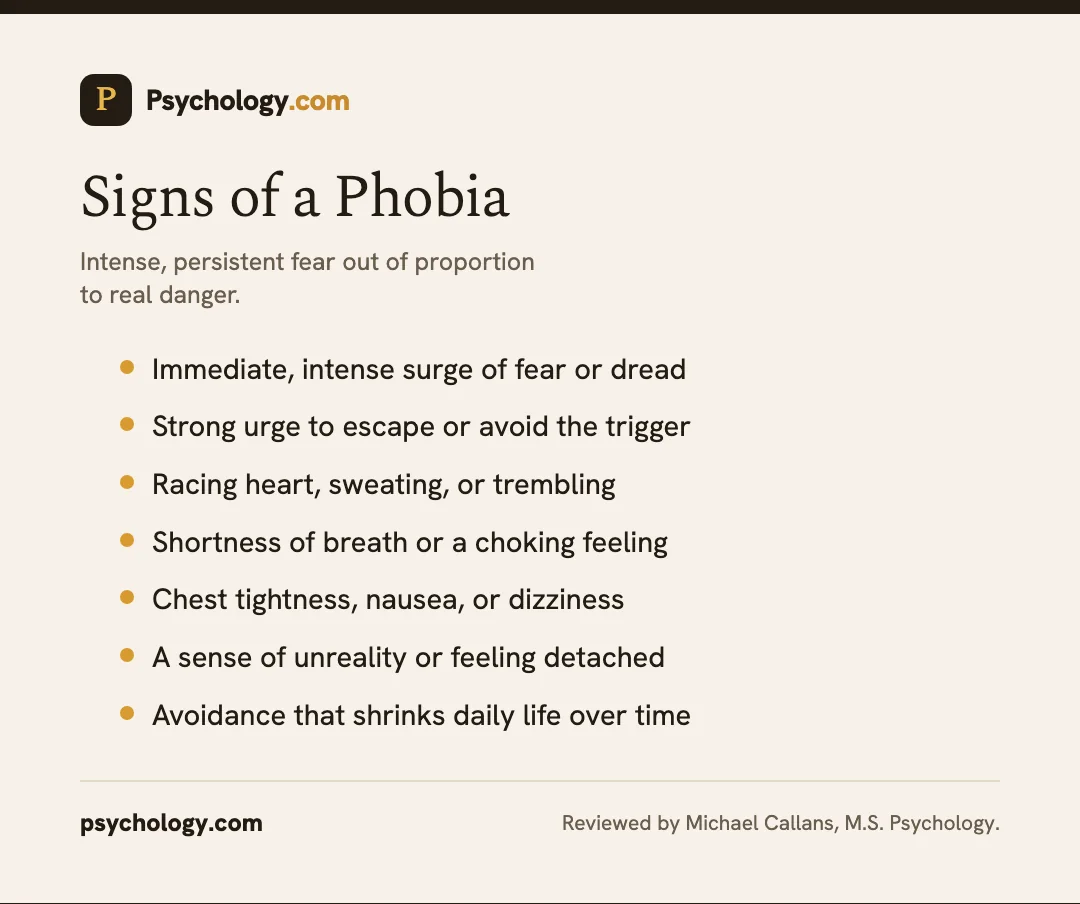
Exposure to the feared object or situation, or even thinking about it, can trigger:
- An immediate, intense surge of fear or dread
- A strong urge to escape or avoid the trigger
- Racing heart, sweating, or trembling
- Shortness of breath or a choking feeling
- Chest tightness, nausea, or dizziness
- A sense of unreality or feeling detached
- In children, crying, clinging, freezing, or tantrums
The defining feature is avoidance. People reorganize their lives to steer clear of the trigger, which can limit work, travel, healthcare, and relationships. Even anticipating contact with the feared object can set off symptoms, so someone with a flying phobia may feel intense dread for weeks before a trip, and a person who fears needles may put off important medical care. The fear is genuinely distressing, and people are often frustrated that knowing it is irrational does nothing to switch it off. That gap between what you know and what you feel is a normal part of how phobias work, not a sign that the fear is being exaggerated.
Types of phobias
- Specific phobias: intense fear of a particular thing, such as animals (spiders, dogs), the natural environment (heights, storms), blood or injections, or situations (flying, enclosed spaces).
- Social anxiety disorder (social phobia): fear of being judged, embarrassed, or scrutinized in social or performance situations.
- Agoraphobia: fear of places or situations where escape might be hard or help unavailable, such as crowds or public transport. It is closely linked to panic disorder.
The blood-injection-injury type is worth a note. Unlike most phobias, which raise heart rate and blood pressure, it can cause a sharp drop that leads to fainting. Knowing this helps a therapist tailor treatment, for example by teaching a technique to keep blood pressure up during exposure.
Causes and risk factors
There is no single cause. Phobias usually develop from a mix of factors:
- Biology: genetics and brain chemistry. Phobias and anxiety can run in families.
- Experiences: a frightening or traumatic encounter with the trigger, such as a dog bite or turbulence on a flight.
- Learning: observing fear in others, often a parent, during childhood, or absorbing warnings about a danger.
- Temperament: a naturally cautious or anxious disposition.
Most specific phobias first appear in childhood or adolescence, often by around age ten, though they can begin at any age. Avoidance is what keeps a phobia alive. Steering clear of the trigger brings quick relief, which teaches the brain that the fear was justified, so the fear grows stronger over time. This is exactly the cycle that treatment is designed to break.
How phobias are treated
Phobias are among the most successfully treated mental health conditions, and therapy is the primary approach.
Psychotherapy
Exposure therapy is the most effective treatment, and the American Psychological Association describes it as a well-established approach for confronting feared objects and situations in a safe, structured way. Working with a therapist, you face the trigger gradually until the fear response fades. This can be done in real life (in vivo), through imagination, or with virtual reality, and is often paced as graded exposure or systematic desensitization, starting with mildly anxiety-provoking steps and building up. Cognitive behavioral therapy (CBT) adds skills to challenge the thoughts that maintain the phobia. Many people see lasting improvement, and some specific phobias respond in just a few sessions.
Medication
Medication is not usually the main treatment for specific phobias, but it can help in some cases. The NHS notes that antidepressants, beta blockers, or short-term sedatives are sometimes used, particularly for social anxiety, agoraphobia, or when a phobia occurs alongside other anxiety. Beta blockers can blunt physical symptoms such as a racing heart in a feared situation. Any medication should be started and monitored by a prescriber. Learn more about antidepressants.
Lifestyle and self-care
Relaxation and slow-breathing techniques, regular physical activity, and good sleep help manage the anxiety that surrounds a phobia. These complement, but do not replace, professional treatment.
Which professional to see
For most phobias, a psychologist or licensed therapist trained in exposure therapy or CBT is the right first contact, and no medical referral is usually needed. If medication may help, particularly for social anxiety or co-occurring anxiety, a psychiatrist or primary care doctor can prescribe and monitor it. For blood, injection, or medical phobias that interfere with care, mention it to your doctor so the team can plan accordingly.
Wondering where you stand? Take the phobia test, the agoraphobia test, or the GAD-7 based anxiety test: free, confidential, about 3 minutes, with an instant plain-language result and a PDF you can bring to a professional. A screening is not a diagnosis.
When to seek help
Reach out to a mental health professional if a fear is intense, persistent, and causes you to avoid situations in a way that limits your work, relationships, or daily life. Because phobias respond so well to treatment, there is no reason to keep living around the fear. Getting help early stops avoidance from spreading.
Frequently asked questions
What is the difference between a fear and a phobia?
A fear is a normal, proportionate reaction to a real threat. A phobia is an intense, persistent fear that is out of proportion to the actual danger, lasts six months or more, and drives avoidance that disrupts daily life.
Can phobias be cured?
Yes, many people recover fully. Exposure therapy in particular has a strong track record, and some specific phobias improve in just a few sessions.
Are phobias a type of anxiety disorder?
Yes. Phobias are classified as anxiety disorders. They share the same fight-or-flight physical symptoms as other forms of anxiety but are focused on a specific trigger.
Related conditions
Therapists who specialize in phobias
Connect with a licensed therapist on Psychology.com who works with phobias.
- A FAMILY MATTER
- Advance Thru Psychotherapy and Family Development
- Anne Ciota
- Arlyn P. Stern LCSW
- Asktheinternettherapist.com
- Barbara L Edwards
Finding the right help
When you are ready to take the next step, these guides walk you through finding and starting with the right therapist.
- Getting started with therapy
- How to find the right therapist
- Find a therapist who takes insurance
- Free & low-cost therapy
References
- National Institute of Mental Health (NIMH): Specific Phobia Statistics (past-year and lifetime prevalence)
- NHS: Phobias, Overview and Treatment
- American Psychological Association: Exposure Therapy
- Mayo Clinic: Specific Phobias, Symptoms and Causes