Key facts
- Schizophrenia affects how a person thinks, feels, and perceives the world.
- It is a chronic condition, but symptoms can be managed with treatment.
- The main treatments are antipsychotic medication combined with psychosocial support.
- Symptoms usually first appear in the late teens to early thirties.
What is schizophrenia?
Schizophrenia is a serious mental health condition that affects how a person interprets reality. It can involve hallucinations, delusions, disorganized thinking, and changes in motivation and emotion. These experiences can make it hard to tell what is real, manage emotions, relate to others, and function day to day.
Schizophrenia is not a "split personality," and most people with the condition are not violent. It is a brain-based illness with strong genetic and biological roots. While it is a lifelong condition for most, treatment can reduce symptoms and help people work, study, and maintain relationships. It is relatively uncommon. The World Health Organization estimates that schizophrenia affects about 24 million people worldwide, or roughly 1 in 300. In the United States, the National Institute of Mental Health puts the prevalence of schizophrenia and related psychotic disorders at between 0.25% and 0.64% of adults.
Clinicians diagnose schizophrenia using criteria from the American Psychiatric Association's DSM-5. In plain terms, a diagnosis generally requires two or more core symptoms, such as delusions, hallucinations, or disorganized speech, present for a significant part of a month, with some signs of disturbance lasting at least six months and a clear impact on work, relationships, or self-care. At least one of the core symptoms must be delusions, hallucinations, or disorganized speech. Because other conditions and substances can produce similar symptoms, a thorough evaluation rules those out first. This framing is for understanding, not self-diagnosis.
Symptoms
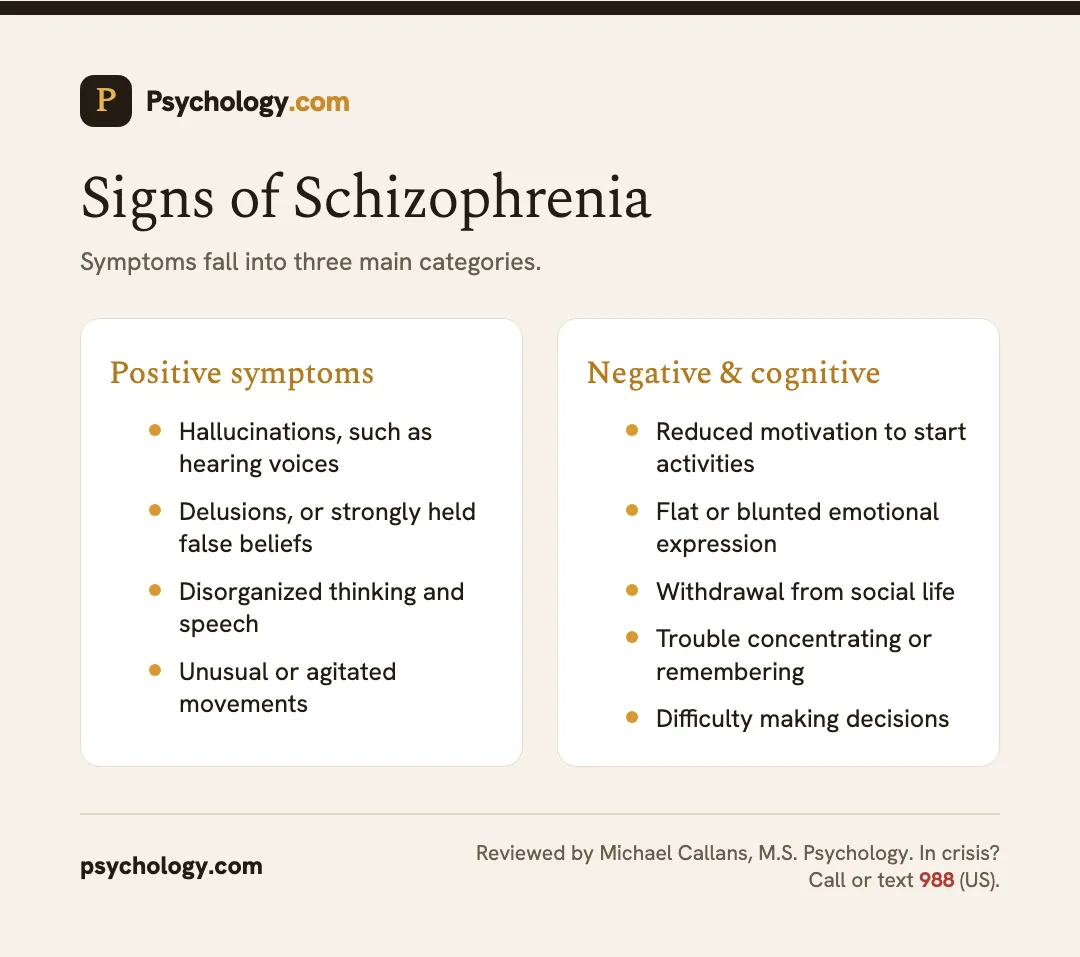
Symptoms of schizophrenia are usually grouped into three categories.
Positive symptoms are experiences added to normal functioning:
- Hallucinations, such as hearing voices that others do not hear
- Delusions, or strongly held false beliefs
- Disorganized thinking and speech
- Unusual or agitated movements
Negative symptoms reflect a reduction in normal functioning:
- Reduced motivation or ability to start activities
- Flat or blunted emotional expression
- Withdrawal from social life
- Difficulty experiencing pleasure
Cognitive symptoms affect memory and thinking:
- Trouble concentrating or paying attention
- Problems with memory and processing information
- Difficulty making decisions
Symptoms usually first appear in the late teens to early thirties, and the NHS and NIMH note that onset tends to be slightly earlier in men than in women. The first clear episode of psychosis is often preceded by a quieter period, sometimes called the prodrome, in which mood, sleep, motivation, and social interest gradually change. Recognizing this early phase matters, because getting help sooner is linked to better long-term outcomes.
Causes and risk factors
There is no single cause. Schizophrenia is thought to result from a mix of factors:
- Genetics: the condition runs in families, and having a close relative with schizophrenia raises risk. No single gene causes it; many small genetic influences add up.
- Brain chemistry and structure: differences in brain development and in chemical messengers, particularly dopamine, may play a role.
- Environment: complications during pregnancy or birth, and significant early-life stress or adversity, may contribute.
- Substance use: heavy use of certain drugs, especially high-potency cannabis during the teen years and early adulthood, is associated with greater risk.
Having a risk factor does not mean a person will develop schizophrenia, and most people exposed to these factors never do. It is no one's fault and is not caused by personal weakness or upbringing. Researchers increasingly describe it as a neurodevelopmental condition, meaning subtle differences in how the brain develops over years can set the stage long before symptoms appear, with stress and other triggers tipping the balance later. Understanding it this way helps explain why early support matters and why blame, of the person or their family, is both inaccurate and unhelpful.
How schizophrenia is treated
Schizophrenia is a long-term condition, but treatment can control symptoms and support recovery. Care usually combines medication with therapy and practical support, and works best when started early and maintained over time. The World Health Organization notes that effective care exists yet remains hard to access for many, estimating that only about 29% of people with psychosis receive specialist mental health care worldwide.
Medication
Antipsychotic medications are the foundation of treatment. They help reduce or manage hallucinations, delusions, and disordered thinking, largely by acting on dopamine signaling in the brain. Options include older (first-generation) antipsychotics such as haloperidol and newer (second-generation) ones such as risperidone, olanzapine, aripiprazole, and quetiapine. For people whose symptoms do not respond to other medications, clozapine can be effective but requires regular blood monitoring. Long-acting injectable forms can help with consistency. A prescriber adjusts the type and dose to balance effectiveness with side effects, and steady use helps prevent relapse.
Psychosocial treatment
Therapy and support help people manage symptoms, improve daily skills, and reach personal goals. This can include cognitive behavioral therapy for psychosis, social skills training, supported employment and education, psychoeducation, and family involvement. The WHO specifically lists psychoeducation, family interventions, cognitive behavioral therapy, and psychosocial rehabilitation among effective care options.
Coordinated and ongoing support
Care that connects medical treatment, therapy, family involvement, and community services produces the best outcomes, especially when started soon after symptoms begin. NIMH highlights coordinated specialty care, a team-based, recovery-oriented model for early psychosis that combines medication, therapy, family support, and help with work or school. A stable routine and a strong support network are important.
Which professional to see
A psychiatrist diagnoses schizophrenia and manages antipsychotic medication, and is usually the central clinician. Psychologists, licensed therapists, and clinical social workers provide therapy and skills support, often as part of a coordinated team. If you suspect early psychosis in yourself or a loved one, a primary care doctor can make an urgent referral, and many regions have specialized early-psychosis programs. During an acute episode with risk of harm, seek emergency care right away.
Wondering where you stand? Take Take the psychosis risk screener or the paranoia test (R-GPTS): free, confidential, a few minutes each, with an instant plain-language result and a PDF you can bring to a professional. A screening is not a diagnosis.
When to seek help
Reach out to a doctor or mental health professional if you or someone you care about experiences hallucinations, delusions, disorganized thinking, or a marked withdrawal from daily life. Seek help immediately if there are thoughts of self-harm or suicide. Early treatment improves long-term outcomes, so do not wait to get an evaluation.
Frequently asked questions
Does schizophrenia mean having a split personality?
No. This is a common misconception. Schizophrenia affects how a person perceives and interprets reality. It is not the same as dissociative identity disorder, which involves separate identities.
Can people with schizophrenia recover?
Schizophrenia is usually a lifelong condition, but many people manage their symptoms well with ongoing treatment and go on to work, study, and maintain relationships. Early, consistent care improves outcomes.
Are people with schizophrenia dangerous?
Most people with schizophrenia are not violent. They are far more likely to be harmed or to harm themselves than to harm others. Stigma often comes from misunderstanding the condition.
Related conditions
Therapists who specialize in schizophrenia
Connect with a licensed therapist on Psychology.com who works with schizophrenia.
- Charles H. Browning
- Dr. Joe A Baez
- Dr. Richard Alperin
- Dr. SARA J CORNELL
- Dr. Vicki D. Coleman
- Dr. Virginia Ann Rockhill
Finding the right help
When you are ready to take the next step, these guides walk you through finding and starting with the right therapist.
- Getting started with therapy
- How to find the right therapist
- Find a therapist who takes insurance
- Free & low-cost therapy
References
- National Institute of Mental Health (NIMH): Schizophrenia (symptoms, age of onset, coordinated specialty care)
- NIMH: Schizophrenia Statistics (U.S. prevalence)
- World Health Organization: Schizophrenia Fact Sheet (global prevalence and care)
- NHS: Schizophrenia, Overview and Treatment
- Mayo Clinic: Schizophrenia, Symptoms and Causes