

Key facts
- ADHD is one of the most common neurodevelopmental conditions, usually first identified in childhood.
- It is not caused by poor parenting, laziness, or lack of effort.
- There are three presentations: inattentive, hyperactive-impulsive, and combined.
- Effective treatments exist, and many adults are diagnosed for the first time later in life.
What is ADHD?
Attention-deficit/hyperactivity disorder (ADHD) is a neurodevelopmental condition that affects how a person regulates attention, impulses, and activity. People with ADHD may find it harder to focus on tasks that do not interest them, to sit still, to wait their turn, or to organize and follow through on plans. These differences are present across settings and tend to appear early in life. Researchers often describe ADHD as a difference in executive function, the set of mental skills that help us plan, prioritize, manage time, and resist distraction.
ADHD reflects natural variation in how the brain develops and works, particularly in systems that manage attention and self-regulation. It is a recognized medical condition, not a character flaw or a question of willpower, and it is also common. According to the Centers for Disease Control and Prevention (CDC), an estimated 7 million US children aged 3 to 17, about 11.4%, have been diagnosed with ADHD as of 2022. It often continues into adulthood, where it remains one of the most frequently diagnosed mental health conditions. Many people with ADHD bring real strengths, including creativity, energy, and the ability to focus intensely on things they find engaging.
Signs and symptoms
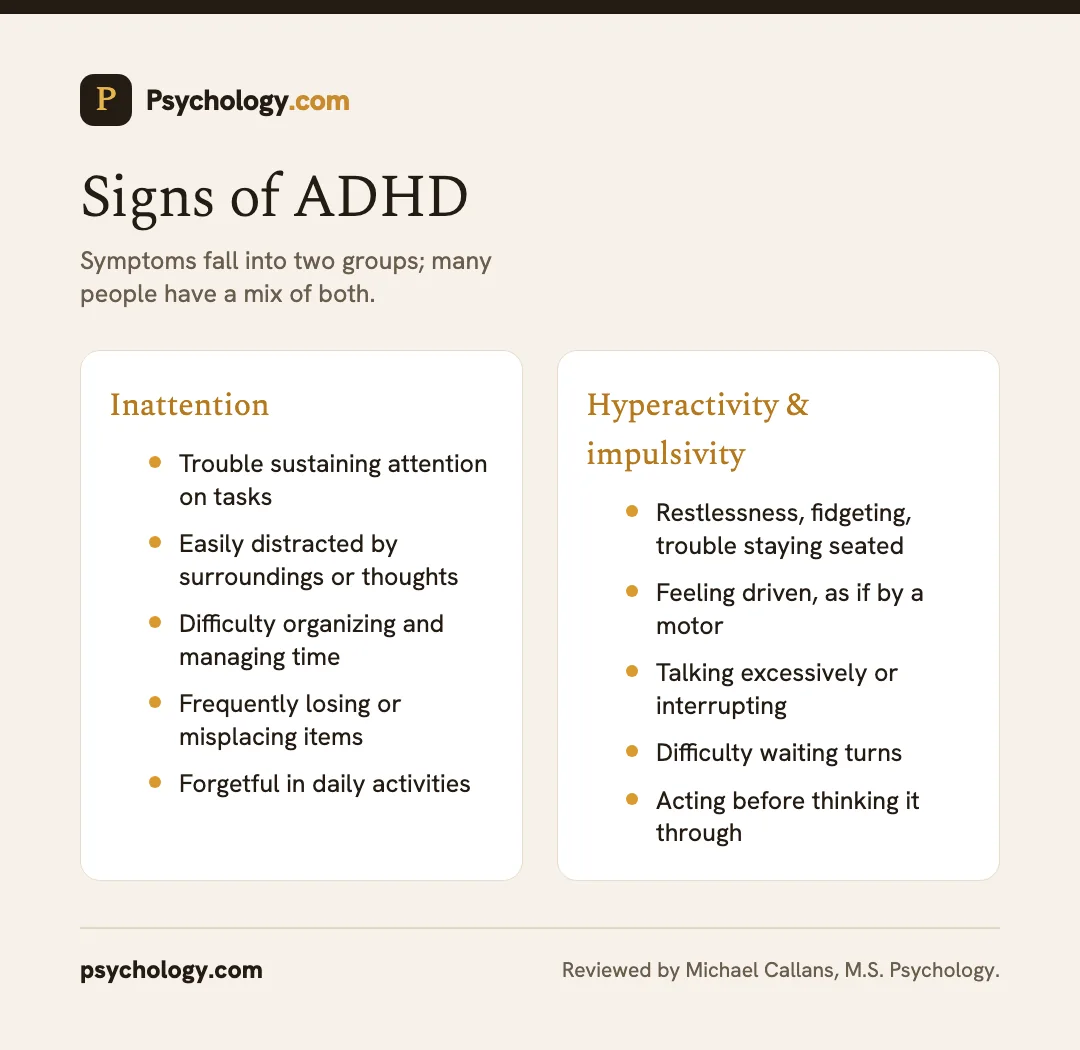
ADHD symptoms fall into two broad groups. A person may have mostly one group, or a mix of both.
Inattention
- Trouble sustaining attention on tasks, reading, or conversations
- Easily distracted by surroundings or unrelated thoughts
- Difficulty organizing tasks, managing time, and meeting deadlines
- Frequently losing or misplacing items
- Forgetfulness in daily activities and appointments
- Avoiding tasks that require sustained mental effort
Hyperactivity and impulsivity
- Restlessness, fidgeting, or difficulty staying seated
- Feeling driven, as if powered by a motor
- Talking excessively or interrupting others
- Difficulty waiting turns
- Acting before thinking through consequences
In adults, hyperactivity often looks less like physical restlessness and more like inner restlessness, racing thoughts, or chronic difficulty with organization and follow-through. Adults may also notice trouble managing money, frequently changing jobs or relationships, difficulty starting boring tasks, and a tendency to hyperfocus intensely on things they find rewarding. Many describe time blindness, a sense that time slips away or that future deadlines do not feel real until they are urgent.
ADHD also frequently occurs alongside other conditions. It is common for people with ADHD to also experience anxiety, depression, learning differences, or sleep problems, and recognizing these together leads to better, more complete support.
Types of ADHD
The DSM-5, the diagnostic manual used by US clinicians, describes three presentations of ADHD. A person's presentation can shift over time, for example as a hyperactive child grows into an adult whose main difficulty is inattention.
- Predominantly inattentive presentation: attention and organization difficulties dominate, with little hyperactivity. This was once informally called ADD and is easy to miss, especially in girls and quieter children, because it is less disruptive.
- Predominantly hyperactive-impulsive presentation: restlessness and impulsivity dominate, with fewer attention problems. This pattern is more often recognized in young children.
- Combined presentation: significant symptoms from both groups, the most common pattern.
Causes and risk factors
There is no single cause. Research points to a combination of factors:
- Genetics: ADHD runs strongly in families and is highly heritable.
- Brain development: differences in the development and function of attention-regulating brain networks.
- Prenatal and early-life factors: premature birth, low birth weight, or exposure to alcohol, tobacco, or certain toxins during pregnancy may increase risk.
Despite common myths, ADHD is not caused by too much sugar, screen time, or by parenting style, though environment can affect how symptoms show up day to day.
How ADHD is diagnosed
There is no single blood test or brain scan for ADHD. A qualified professional, such as a pediatrician, psychologist, or psychiatrist, makes the diagnosis through a careful evaluation guided by the DSM-5 criteria. This usually includes a detailed developmental and life history, standardized rating scales completed by the person and by parents or teachers, and ruling out other conditions that can look similar, such as anxiety, depression, learning differences, thyroid problems, or sleep disorders.
For a diagnosis, several symptoms must have been present before age 12, occur in more than one setting (such as home and school, or work and home), and meaningfully interfere with daily functioning. A careful evaluation matters, because both over-diagnosis and under-diagnosis are possible, and an accurate picture leads to the right support.
Support and treatment
ADHD is highly manageable. According to the National Institute of Mental Health, standard treatment combines medication with psychosocial approaches such as behavioral therapy, parent training, and school or workplace support. The best results usually come from a combined, individualized plan rather than any single intervention. For young children (under 6), clinical guidelines recommend starting with behavior therapy and parent training before considering medication.
Behavioral and psychological support
Behavioral therapy, parent training in behavior management for younger children, ADHD coaching, and skills-based approaches like cognitive behavioral therapy help build routines, organization, and self-regulation strategies. Classroom accommodations and, for adults, workplace adjustments such as written instructions, flexible deadlines, or a quieter environment can make a real difference.
Medication
Medication is one of the most studied and effective treatments for ADHD. There are two broad classes. Stimulants (such as methylphenidate-based and amphetamine-based medicines) are the most commonly prescribed and work quickly for many people. Non-stimulants (such as atomoxetine and certain alpha-2 agonists like guanfacine and clonidine) are alternatives when stimulants are not suitable, not tolerated, or not preferred. All ADHD medication should be prescribed and monitored by a qualified clinician, who will adjust the type and dose over time.
Everyday strategies
Consistent routines, external reminders and calendars, breaking large tasks into smaller steps, regular physical activity, and good sleep all support attention and self-regulation, and work alongside formal treatment rather than replacing it.
Wondering where you stand? Take the ASRS-based ADHD test, the ADHD test for women, or the executive function test: free, confidential, about 3 minutes, with an instant plain-language result and a PDF you can bring to a professional. A screening is not a diagnosis.
When to seek help
Consider an evaluation if attention, restlessness, or impulsivity consistently get in the way of school, work, relationships, or daily life, in a child or an adult. ADHD often occurs alongside anxiety or depression, so a thorough assessment is worthwhile. Getting support early can ease frustration and unlock strengths.
Frequently asked questions
Can adults have ADHD?
Yes. ADHD is a lifelong condition for most people, and many adults are diagnosed for the first time later in life, often after a child is diagnosed or when work and life demands increase. Adult ADHD is real and treatable.
Is ADHD overdiagnosed?
Diagnosis rates vary, and ADHD can be both over- and under-recognized depending on the setting. The key is a thorough evaluation by a qualified professional rather than a quick checklist, so that the diagnosis is accurate.
Does ADHD mean low intelligence?
No. ADHD is unrelated to intelligence. People with ADHD have the full range of abilities, and many describe particular strengths in creativity, problem-solving, and intense focus on topics that interest them.
Related conditions
Therapists who specialize in adhd
Connect with a licensed therapist on Psychology.com who works with adhd.
- A FAMILY MATTER
- A. Nires
- Advance Thru Psychotherapy and Family Development
- Amy Keller
- Arlyn P. Stern LCSW
- Asktheinternettherapist.com
Finding the right help
When you are ready to take the next step, these guides walk you through finding and starting with the right therapist.
- ADHD or just lazy?
- Getting started with therapy
- How to find the right therapist
- Find a therapist who takes insurance
- Free & low-cost therapy
References
- Centers for Disease Control and Prevention. Data and Statistics on ADHD.
- Centers for Disease Control and Prevention. About ADHD.
- National Institute of Mental Health. Attention-Deficit/Hyperactivity Disorder (ADHD).
- National Institute of Mental Health. ADHD: What You Need to Know.
- National Health Service (UK). Attention deficit hyperactivity disorder (ADHD).