Key facts
- Autism, or autism spectrum disorder (ASD), is a neurodevelopmental difference present from early childhood and lasting throughout life.
- It is a spectrum: autistic people vary widely in strengths, needs, and how they experience the world.
- Autism is not an illness to be cured, and it is not caused by parenting or by vaccines.
- Early understanding and tailored support help autistic people learn, connect, and flourish.
What is autism?
Autism, also called autism spectrum disorder (ASD), is a neurodevelopmental difference that affects how a person communicates, interacts socially, processes information, and experiences sensory input. It is described as a spectrum because autistic people differ enormously from one another. Some have significant support needs and may be non-speaking, while others live fully independently, and many fall somewhere in between. The DSM-5, the manual used by US clinicians, brought several earlier diagnoses, including Asperger syndrome, together under the single category of autism spectrum disorder in 2013.
Autism is far more common than was once believed. The Centers for Disease Control and Prevention (CDC) estimates that about 1 in 31 children (3.2%) aged 8 years has been identified with autism spectrum disorder, based on 2022 monitoring data. Boys are identified with autism more often than girls, though research suggests girls and women are frequently under-identified because their traits can present differently. Autism is a natural form of human variation rather than a disease. Autistic people often have distinctive strengths, such as deep focus on areas of interest, attention to detail, honesty, and original thinking. The goal of support is not to change who someone is, but to help them communicate, learn, and live well in a world that is not always designed for them.
Signs and characteristics
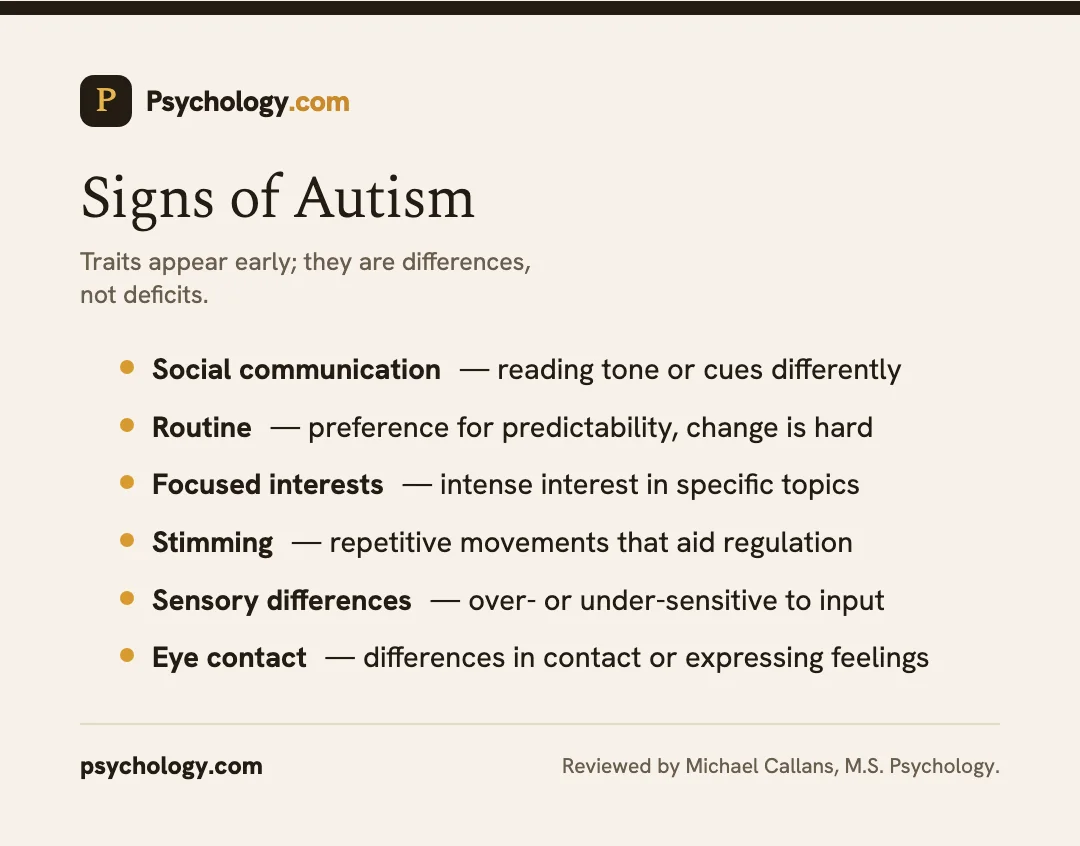
Autistic traits appear in early childhood, though they may be recognized later, especially in those who learn to mask. Common characteristics include:
- Differences in social communication, such as interpreting tone, body language, or unwritten social rules differently
- Preference for routine and predictability, and finding change difficult
- Intense, focused interests in particular topics
- Repetitive movements or actions, sometimes called stimming, which can help with regulation
- Sensory differences, such as being highly sensitive or under-sensitive to sound, light, texture, or touch
- Differences in eye contact or in how feelings are expressed
These traits are not deficits to be eliminated. Many are neutral differences, and some are strengths. According to the CDC, autistic characteristics generally fall into two areas: differences in social communication and interaction, and restricted or repetitive behaviors and interests. Sensory differences are also extremely common. Support focuses on the areas where a person finds daily life genuinely challenging, not on the traits themselves.
Causes and risk factors
Autism arises from differences in early brain development. Research points to a strong genetic component working alongside other factors:
- Genetics: autism is highly heritable, runs in families, and many genes appear to contribute. Having an autistic sibling raises the likelihood for other children.
- Early brain development: differences in how the developing brain forms and connects, beginning before birth.
- Prenatal factors: some factors such as advanced parental age or certain conditions and exposures in pregnancy may modestly influence likelihood.
It is well established that autism is not caused by parenting, by emotional neglect, or by vaccines. As the CDC and major health bodies confirm, the claimed link between vaccines and autism has been thoroughly studied across large populations and disproven. Rising prevalence figures largely reflect broader diagnostic criteria, greater awareness, and better identification, rather than a true epidemic.
How autism is diagnosed
There is no blood test or scan for autism. Diagnosis is made by a specialist team or clinician, such as a developmental pediatrician, psychologist, or psychiatrist, through direct observation, a detailed developmental history, and structured assessment tools. Information from family, and for children from teachers, helps build a full picture. The CDC notes that autism can sometimes be reliably identified by around age 2, although many children are not diagnosed until they are older.
Autism can be identified in early childhood, but many people, particularly girls, women, and those who have learned to mask their traits, are diagnosed in adolescence or adulthood. A later diagnosis can still be very helpful, offering understanding, self-acceptance, access to support and accommodations, and connection to community. If you have concerns about a young child's development, asking for a developmental screening is a reasonable first step.
Support and treatment
Autism is not something to be cured. The aim of support is to help autistic people communicate, develop skills, manage challenges, and live in line with their own goals. Effective support is individualized and respects the person's identity.
Tailored support and therapies
Speech and language support, occupational therapy for sensory and daily-living needs, and skills-based approaches can help where a person wants them. For children, early intervention and family involvement are valuable and can build communication, play, and self-regulation. There is no medication that treats autism itself, though medication may help with specific co-occurring difficulties such as anxiety, sleep, or attention. Support should always be led by the person's strengths and needs, not by pressure to appear non-autistic.
Accommodations and environment
Adjusting the environment often helps more than changing the person: predictable routines, sensory-friendly spaces, clear communication, and understanding from schools and workplaces make a real difference.
Support for co-occurring conditions
Autistic people may also experience anxiety, depression, or ADHD. Treating these conditions, when present, can greatly improve wellbeing and quality of life.
Wondering where you stand? Take the AQ-based autism test, the autism test for women, the autism masking test (CAT-Q), or the PDA test: free, confidential, about 3 minutes, with an instant plain-language result and a PDF you can bring to a professional. A screening is not a diagnosis.
When to seek help
Consider an assessment if a child shows differences in communication, play, or development, such as not responding to their name, limited gestures or eye contact, loss of previously gained skills, or intense distress around change. For adults, it can be worth seeking an assessment when long-standing social, sensory, or routine-related traits affect daily life and you want understanding or support. A good starting point is a primary care doctor, pediatrician, or, for adults, a referral to a clinician experienced with autism. A diagnosis is not a label that limits a person; for many, it brings clarity, self-acceptance, and access to the right help.
Frequently asked questions
Is autism a mental illness?
No. Autism is a neurodevelopmental difference, not a mental illness. It is a lifelong way of experiencing and interacting with the world. Autistic people may also experience mental health conditions, which can be treated separately.
What about Asperger syndrome?
Asperger syndrome is now diagnosed as part of autism spectrum disorder under current diagnostic guidelines. You can read more on our guide to Asperger syndrome.
Can autistic adults live independently?
Many autistic adults live independently, build careers, and form fulfilling relationships, while others need ongoing support. Because autism is a spectrum, the right help looks different for each person, and the focus is on enabling the life they want.
Related conditions
Therapists who specialize in autism
Connect with a licensed therapist on Psychology.com who works with autism.
- Biofeedback Associates of Northeast Florida
- Dr. Joe A Baez
- Dr. SARA J CORNELL
- Dr. Vicki D. Coleman
- Humanistic Counseling Center
- Mr. Jeffrey Crouch
Finding the right help
When you are ready to take the next step, these guides walk you through finding and starting with the right therapist.
- Getting started with therapy
- How to find the right therapist
- Find a therapist who takes insurance
- Free & low-cost therapy
References
- Centers for Disease Control and Prevention. Data and Statistics on Autism Spectrum Disorder.
- Centers for Disease Control and Prevention. Signs and Symptoms of Autism Spectrum Disorder.
- National Institute of Mental Health. Autism Spectrum Disorder.
- World Health Organization. Autism (fact sheet).
- National Health Service (UK). What is autism?.