

Key facts
- Eating disorders are serious medical and mental health conditions, not lifestyle choices or a phase.
- They affect people of all ages, genders, body sizes, and backgrounds.
- The main types are anorexia nervosa, bulimia nervosa, and binge-eating disorder.
- Early treatment improves the chance of full recovery, and most people can get better.
What is an eating disorder?
Eating disorders are illnesses marked by severe and persistent disturbances in eating behaviors, along with distressing thoughts and emotions about food, body shape, and weight. They are among the most serious mental health conditions because they can affect nearly every organ system in the body, including the heart, digestive tract, bones, teeth, and hormones. In the formal diagnostic manual used by clinicians, the DSM-5, these conditions are grouped under the heading of feeding and eating disorders.
An eating disorder is not about vanity or willpower. It is a complex condition with biological, psychological, and social roots. They are also more common than many people realize. The National Institute of Mental Health reports a lifetime prevalence among US adults of about 0.6% for anorexia nervosa, 1.0% for bulimia nervosa, and 2.8% for binge-eating disorder, which makes binge-eating disorder the most common of the three. Eating disorders also carry real medical danger and are associated with some of the highest mortality rates of any mental illness, in part because of medical complications and co-occurring suicide risk. Left untreated, they can become life threatening, but with appropriate care most people recover and rebuild a healthy relationship with food.
Symptoms
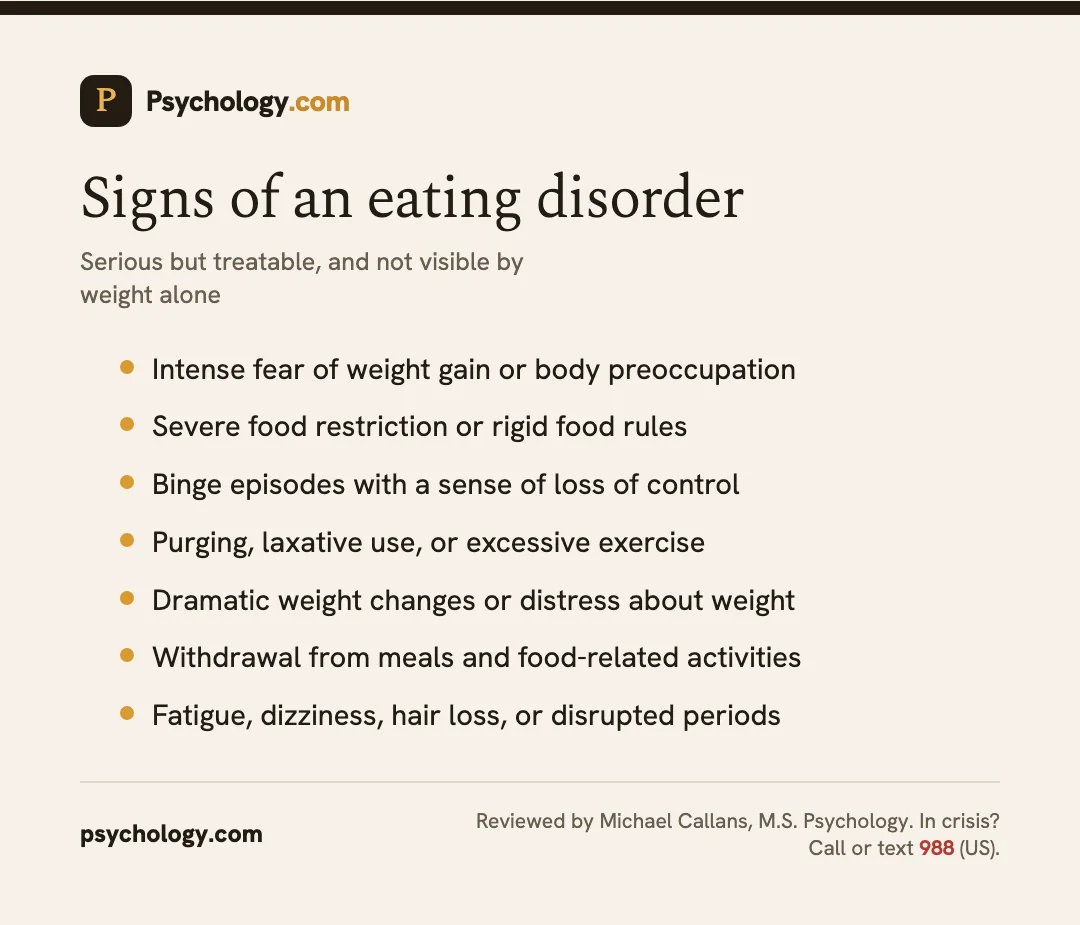
Signs vary by type and person, but common warning signs include:
- Intense fear of gaining weight or strong preoccupation with body shape
- Severe restriction of food, skipping meals, or rigid food rules
- Episodes of eating large amounts of food with a sense of loss of control
- Purging behaviors such as self-induced vomiting, laxative use, or excessive exercise
- Dramatic weight changes, or distress when weight does not change
- Withdrawal from meals, friends, or activities involving food
- Distorted body image or harsh self-judgment about appearance
- Physical effects such as fatigue, dizziness, hair loss, or disrupted periods
You do not need to have every sign, or to be a certain weight, to have an eating disorder that deserves help. Many of the most serious effects, such as electrolyte imbalances, irregular heartbeat, or loss of bone density, are not visible from the outside, which is one reason these illnesses are so often missed.
Types
The National Eating Disorders Association (NEDA) and the DSM-5 recognize several distinct eating disorders. The most common are described below, and a person can move between types over time.
- Anorexia nervosa: severe food restriction, an intense fear of weight gain, and a distorted view of body weight or shape. It can occur in people of any body size; restriction in a person at a higher weight is sometimes called atypical anorexia.
- Bulimia nervosa: cycles of binge eating followed by compensatory behaviors such as self-induced vomiting, fasting, laxative use, or excessive exercise.
- Binge-eating disorder: recurrent episodes of eating large amounts of food with a sense of loss of control, without regular purging. It is the most common eating disorder in the United States and frequently involves shame or distress after eating.
- Avoidant/restrictive food intake disorder (ARFID): limited eating driven by sensory issues, lack of interest in food, or fear of choking, rather than by body image concerns.
- Other specified feeding or eating disorders (OSFED): serious symptoms that do not fit neatly into the categories above. OSFED is common and just as deserving of treatment.
Causes and risk factors
There is no single cause. Eating disorders usually develop from a mix of factors:
- Biology: genetics and brain chemistry. Eating disorders can run in families.
- Psychology: perfectionism, low self-esteem, anxiety, and difficulty managing emotions.
- Social and cultural pressures: dieting, weight stigma, and idealized body images.
- Life events: trauma, major change, or significant stress.
How eating disorders are treated
Eating disorders are treatable, and care usually involves a coordinated team that addresses both the body and the mind, often a therapist, a medical doctor, and a registered dietitian working together. The right plan depends on the type, the severity, the person's age, and their physical health. Care is delivered across a range of settings, from weekly outpatient appointments through to intensive outpatient programs, partial hospitalization, residential care, and, when someone is medically unstable, inpatient hospital treatment.
Psychotherapy
Talk therapy is the foundation of recovery. Cognitive behavioral therapy, and in particular enhanced CBT (CBT-E) designed specifically for eating disorders, helps change the harmful thoughts and behaviors that keep the illness going. Family-based treatment (FBT, sometimes called the Maudsley approach) is widely regarded as the first-line treatment for children and adolescents with anorexia, because it brings parents in as active partners in restoring healthy eating. Interpersonal therapy and dialectical behavior therapy skills can also help, especially with binge eating and emotional regulation.
Medical and nutritional care
Restoring physical health is essential and sometimes urgent. This can include medical monitoring of weight, heart rhythm, and blood chemistry, weight restoration where needed, and structured work with a registered dietitian to normalize eating and rebuild a flexible relationship with food. In severe cases, where a person is medically compromised, more intensive or inpatient care stabilizes the body before deeper psychological work can take hold.
Medication
Medication is not a standalone cure, but it has a role. Certain antidepressants can reduce binge-purge cycles in bulimia, and one stimulant medication is approved in the US specifically for moderate-to-severe binge-eating disorder. Medication is also used to treat co-occurring conditions such as depression or anxiety, which are common alongside eating disorders. Any medication should be prescribed and monitored by a qualified clinician.
Wondering where you stand? Take the eating disorder screener, the anorexia test, the bulimia test, the binge eating test (BES), or the ARFID (NIAS) test: free, confidential, about 3 minutes, with an instant plain-language result and a PDF you can bring to a professional. A screening is not a diagnosis.
When to seek help
Reach out to a doctor or mental health professional if you or someone you care about shows ongoing changes in eating, body image, or weight, or persistent distress around food. You do not need to wait until things feel severe, and you do not need to meet a particular weight to deserve care. Seek help right away for fainting, chest pain, an irregular heartbeat, vomiting blood, or thoughts of self-harm. A good starting point is a primary care doctor, who can check physical health and refer you to specialist eating disorder care. In the US, the National Eating Disorders Association offers a screening tool and information for finding help. Eating disorders are easier to treat the earlier they are caught, so it is always worth speaking up.
Frequently asked questions
Can someone have an eating disorder at a normal weight?
Yes. Many people with eating disorders are at an average or higher weight. You cannot tell whether someone has an eating disorder by looking at them, and weight alone does not determine whether help is needed.
Do eating disorders only affect young women?
No. Eating disorders affect people of all genders, ages, and backgrounds, including men, older adults, and athletes. Anyone experiencing these struggles deserves support.
Is full recovery really possible?
Yes. With appropriate treatment, many people recover fully and maintain a healthy relationship with food. Early and consistent care improves the odds.
Related conditions
Therapists who specialize in eating disorders
Connect with a licensed therapist on Psychology.com who works with eating disorders.
- A FAMILY MATTER
- Advance Thru Psychotherapy and Family Development
- Arlyn P. Stern LCSW
- Asktheinternettherapist.com
- Bonnie Westergreen
- Caring Counseling Center
Finding the right help
When you are ready to take the next step, these guides walk you through finding and starting with the right therapist.
- Getting started with therapy
- How to find the right therapist
- Find a therapist who takes insurance
- Free & low-cost therapy
References
- National Institute of Mental Health. Eating Disorders (statistics).
- National Institute of Mental Health. Eating Disorders: About More Than Food.
- National Eating Disorders Association. What Are Eating Disorders?.
- Mayo Clinic. Eating disorders: Symptoms and causes.
- National Health Service (UK). Overview: Eating disorders.