

Key facts
- OCD involves unwanted, intrusive thoughts (obsessions) and repetitive behaviors (compulsions).
- It is a recognized medical condition, not a personality quirk or a preference for tidiness.
- The most effective treatment is a form of therapy called exposure and response prevention.
- Medication and therapy together help most people significantly reduce symptoms.
What is OCD?
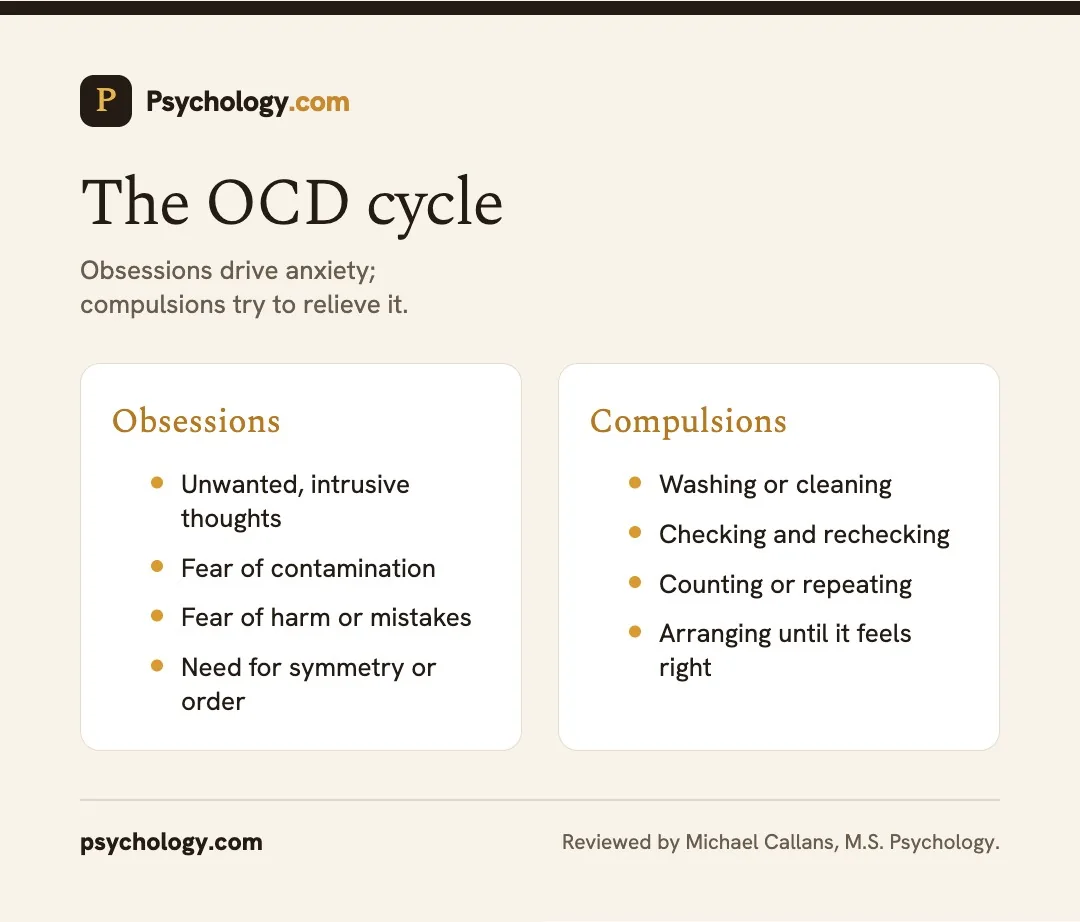
Obsessive-compulsive disorder (OCD) is a mental health condition defined by a cycle of obsessions and compulsions. Obsessions are unwanted, intrusive thoughts, images, or urges that cause intense anxiety. Compulsions are repetitive behaviors or mental acts a person feels driven to perform to relieve that anxiety or prevent a feared outcome. The two feed each other: an obsession sparks distress, the compulsion eases it for a moment, and the brain learns to repeat the ritual the next time the thought returns.
The relief from a compulsion is brief, which keeps the cycle going. OCD is more than liking things neat or being careful. The obsessions and compulsions are time-consuming, distressing, and interfere with daily life. It is a real condition with biological roots, and it responds well to specialized treatment. OCD is closely related to anxiety and shares some features with it, though the Diagnostic and Statistical Manual of Mental Disorders (DSM-5), published by the American Psychiatric Association, now classifies it in its own category of obsessive-compulsive and related disorders rather than among the anxiety disorders.
OCD is also more common than many people assume. According to the National Institute of Mental Health (NIMH), it affects roughly 1 to 2 percent of U.S. adults, and the World Health Organization (WHO) recognizes it as a notable cause of disability worldwide. In DSM-5 terms, a diagnosis generally involves obsessions, compulsions, or both that are time-consuming (often described as taking more than an hour a day) or that cause significant distress or difficulty functioning. This page paraphrases that framework in plain language; only a qualified professional can make an actual diagnosis.
Symptoms
OCD symptoms fall into two connected parts.
Obsessions are recurring, unwanted thoughts or fears, such as:
- Fear of contamination by germs or dirt
- Disturbing intrusive thoughts about harm, religion, or sex
- A need for symmetry, order, or exactness
- Excessive doubt and a need for reassurance
Compulsions are repetitive behaviors performed to ease the anxiety, such as:
- Excessive washing, cleaning, or hand-washing
- Repeated checking, for example of locks or appliances
- Counting, tapping, or repeating words silently
- Arranging items until they feel "just right"
- Seeking reassurance over and over
People with OCD often recognize that their thoughts and behaviors are excessive, but feel unable to stop them. A key point that surprises many people is that intrusive thoughts in OCD are often the opposite of what the person values: someone gentle may be tormented by violent images, and someone caring may fear they will harm a loved one. These thoughts are a symptom, not a reflection of character or intent. Compulsions are not always visible, either. Mental rituals such as silently reviewing events, praying to neutralize a thought, or seeking constant reassurance count as compulsions even when no one else can see them. The Mayo Clinic notes that symptoms often begin gradually and tend to worsen during times of stress.
Causes and risk factors
There is no single cause. OCD is thought to develop from a combination of factors:
- Genetics: OCD can run in families, and having a close relative with it raises risk.
- Brain function: differences in certain brain circuits and chemical messengers are associated with OCD.
- Environment and stress: stressful or traumatic events can trigger or worsen symptoms in some people.
- Temperament: tendencies toward anxiety or heightened responsibility may contribute.
OCD usually begins in childhood, adolescence, or early adulthood, and the NIMH notes that the average age of onset is in the late teens to early twenties. It affects people of all genders and backgrounds. In a small number of cases, particularly in children, a sudden onset of symptoms has been linked to certain infections, though most OCD develops gradually. As with other mental health conditions, these factors raise risk but do not guarantee that someone will develop OCD.
How OCD is treated
OCD is highly treatable. Most people see significant improvement with the right therapy, medication, or a combination of the two. The condition rarely resolves on its own, so getting the specific, evidence-based care described below makes a real difference.
Exposure and response prevention
Exposure and response prevention (ERP) is the most effective therapy for OCD and is considered the first-line treatment. It is a specialized form of cognitive behavioral therapy (CBT) in which a person gradually and deliberately faces the situations that trigger their obsessions, such as touching a doorknob, while learning to resist performing the compulsion that would normally follow, such as washing. With repetition, the anxiety fades on its own, and the brain learns that the feared outcome does not happen. Because ERP requires specific training, it helps to look for a therapist experienced in treating OCD. The skills carry forward, so people can keep using them long after formal treatment ends.
Medication
Certain antidepressants, particularly selective serotonin reuptake inhibitors (SSRIs) such as fluoxetine, sertraline, and fluvoxamine, are commonly used to reduce OCD symptoms and are often combined with therapy. OCD frequently responds to higher doses than are typically used for depression, and medication can take several weeks, sometimes up to a few months, to reach full effect. The tricyclic antidepressant clomipramine is another well-established option. All medication should be managed by a prescriber. Learn more about antidepressants.
Combined and ongoing care
For many people, combining ERP with medication works better than either alone, especially when symptoms are moderate to severe. Support, education, and consistent practice of therapy skills help maintain progress over time, and treatment can be adjusted if symptoms flare during stressful periods.
When to see a therapist vs. a psychiatrist
Because ERP is so central to treating OCD, a therapist trained in this approach is often the most important member of the care team. A psychiatrist (a medical doctor) can diagnose OCD, prescribe and adjust medication, and help with more severe or treatment-resistant cases. Many people see both, pairing ERP with medication. If you are not sure where to start, your primary care doctor can evaluate your symptoms, begin treatment, and refer you to a therapist or psychiatrist who specializes in OCD.
Wondering where you stand? Take the OCD screener, the skin picking (dermatillomania) test, the hair pulling (trichotillomania) test, the hoarding test (HRS-SR), or the body dysmorphia test: free, confidential, about 3 minutes, with an instant plain-language result and a PDF you can bring to a professional. A screening is not a diagnosis.
When to seek help
Reach out to a doctor or mental health professional if obsessions and compulsions take up significant time, cause distress, or interfere with work, relationships, or daily life. A common sign that it is time to seek help is when rituals start to dictate your schedule, when you avoid people or places to prevent triggering an obsession, or when family members are drawn into providing reassurance or taking part in rituals. Many people live with OCD for years before getting a diagnosis, often out of embarrassment about the content of their thoughts, but clinicians who treat OCD have heard it all and will not judge you. OCD rarely improves on its own, but it responds well to treatment, and getting help early makes recovery easier.
Frequently asked questions
Is being neat or organized the same as having OCD?
No. Liking order is a preference. OCD involves distressing, intrusive thoughts and compulsions that a person feels unable to control and that interfere with daily life.
Can OCD be cured?
There is no single cure, but OCD is very treatable. With exposure and response prevention, medication, or both, most people reduce their symptoms substantially and regain control of their daily lives.
Why do compulsions feel impossible to stop?
Compulsions briefly relieve the anxiety caused by obsessions, which reinforces the behavior. That short-term relief makes the cycle self-sustaining, which is exactly what exposure and response prevention is designed to break.
Related conditions
Therapists who specialize in ocd
Connect with a licensed therapist on Psychology.com who works with ocd.
- Advance Thru Psychotherapy and Family Development
- Arlyn P. Stern LCSW
- Asktheinternettherapist.com
- Barbara L Edwards
- Biofeedback Associates of Northeast Florida
- Caring Counseling Center
Finding the right help
When you are ready to take the next step, these guides walk you through finding and starting with the right therapist.
- OCD or PTSD?
- Getting started with therapy
- How to find the right therapist
- Find a therapist who takes insurance
- Free & low-cost therapy
References
- National Institute of Mental Health (NIMH): Obsessive-Compulsive Disorder
- National Institute of Mental Health (NIMH): OCD statistics
- World Health Organization (WHO): Obsessive-compulsive disorder fact sheet
- Mayo Clinic: Obsessive-compulsive disorder (OCD)
- NHS: Overview of obsessive compulsive disorder (OCD)
- American Psychiatric Association (APA): What is obsessive-compulsive disorder?