

Key facts
- Alzheimer's disease is the most common cause of dementia.
- It is a progressive disease, meaning symptoms worsen gradually over years.
- There is no cure, but treatments can ease symptoms and support quality of life.
- It is a disease of the brain, not a normal or inevitable part of aging.
What is Alzheimer's disease?
Alzheimer's disease is a progressive brain disorder that slowly destroys memory, thinking skills, and eventually the ability to carry out the simplest tasks. It is the most common cause of dementia, the umbrella term for a serious decline in cognitive abilities. Put simply, dementia describes the pattern of symptoms, and Alzheimer's is the specific disease behind most of them. The National Institute on Aging describes Alzheimer's as the most common cause of dementia among older adults, accounting for the majority of cases.
The disease is associated with the buildup of abnormal proteins in and around brain cells, specifically amyloid plaques between neurons and tangles of a protein called tau inside them. These deposits disrupt how brain cells connect and communicate and eventually cause them to die, so the brain gradually loses tissue and function. A key point that surprises many people is timing: these changes can begin in the brain years, even a decade or more, before the first noticeable symptoms appear. That long silent phase is why the disease is sometimes well established by the time memory problems become obvious.
Alzheimer's is also common. The Alzheimer's Association reports that an estimated 7 million Americans aged 65 and older are living with Alzheimer's dementia, a number projected to grow as the population ages. If your main concern is forgetfulness rather than a confirmed diagnosis, our guide to memory loss may help you sort out what is worth evaluating.
Symptoms
The most familiar early symptom is difficulty remembering newly learned information. As the disease progresses, symptoms grow more serious and may include:
- Memory loss that disrupts daily life, especially forgetting recent events
- Difficulty with planning, problem-solving, or familiar tasks
- Confusion about time, place, or recent conversations
- Trouble finding the right words or following discussions
- Misplacing items and being unable to retrace steps
- Poor judgment and withdrawal from work or social activities
- Changes in mood, personality, anxiety, or suspicion
- In later stages, difficulty walking, swallowing, and recognizing loved ones
Stages of Alzheimer's disease
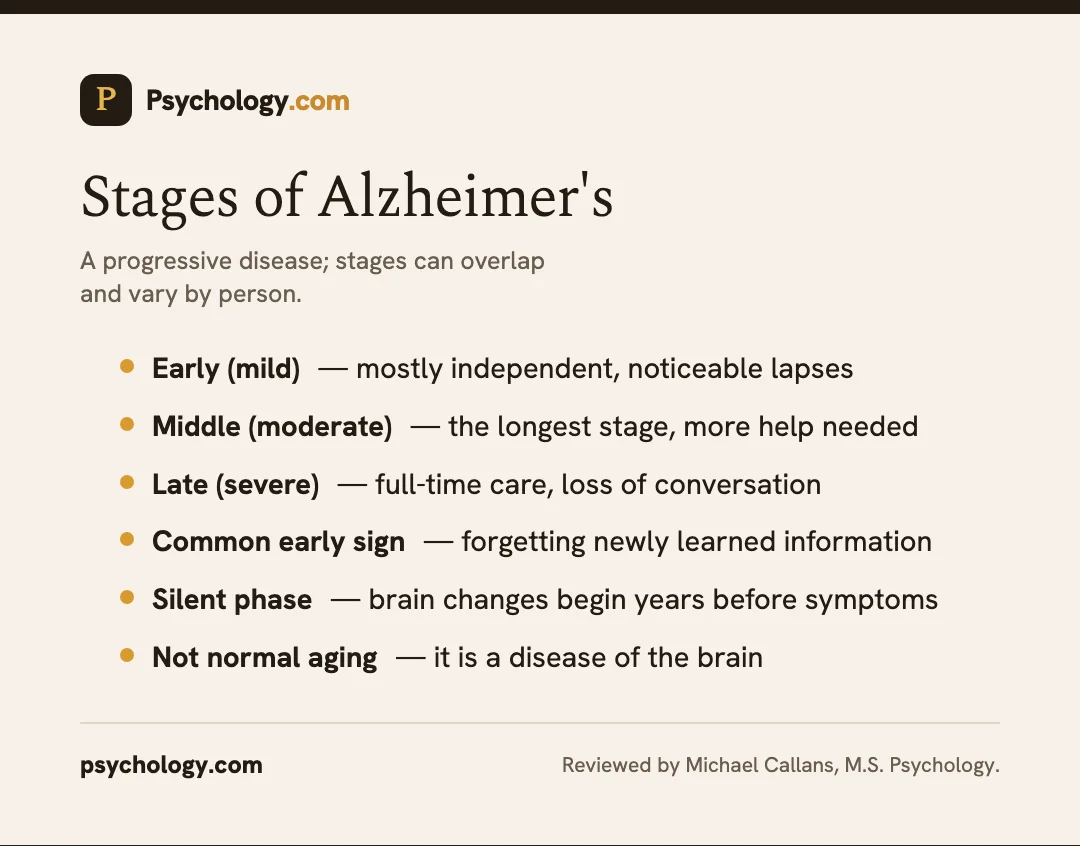
- Early (mild): the person can often function independently but has noticeable lapses, such as forgetting words, names, or recent events, and may need more help with complex tasks.
- Middle (moderate): usually the longest stage. Confusion grows, daily tasks need more assistance, and mood or behavior changes become more pronounced.
- Late (severe): the person needs full-time care, loses the ability to hold a conversation and control movement, and becomes vulnerable to infections.
Progression varies widely from person to person, and stages can overlap. The National Institute on Aging notes that the time from diagnosis to the later stages differs greatly between individuals, influenced by age, other health conditions, and how early the disease was identified. Researchers also recognize a preclinical phase, in which brain changes are underway but a person still functions normally, followed by mild cognitive impairment before dementia itself develops.
Diagnosis
No single test diagnoses Alzheimer's. Doctors arrive at a diagnosis through a combination of a careful medical and family history, cognitive and memory testing, a neurological exam, and laboratory tests and brain imaging that help rule out other causes such as stroke, tumors, thyroid disease, or vitamin deficiency. The Alzheimer's Association notes that newer biomarker tools, including specialized PET scans and tests of cerebrospinal fluid, can detect the underlying brain changes and are increasingly used in specialist and research settings. A clear diagnosis lets families plan, access support, and consider treatments while they can do the most good.
Causes and risk factors
The exact cause is not fully understood, but it likely involves a mix of genetic, lifestyle, and environmental factors that affect the brain over time. Known risk factors include:
- Age: the greatest risk factor, with risk rising significantly after 65 and continuing to climb with each decade. Age alone does not cause the disease, however.
- Family history and genetics: having a parent or sibling with Alzheimer's raises risk. A gene variant called APOE-e4 is the strongest known genetic risk factor for the common late-onset form, though carrying it does not guarantee the disease, and rare inherited forms can cause early-onset Alzheimer's.
- Heart health: high blood pressure, diabetes, high cholesterol, obesity, and smoking are associated with higher risk, reflecting the close link between cardiovascular and brain health.
- Head injury: a history of moderate to severe head trauma.
- Lifestyle: physical inactivity, poor sleep, untreated hearing loss, and limited social or mental engagement may contribute.
How Alzheimer's disease is treated
There is no cure, but treatment can temporarily improve symptoms, support function, and help maintain quality of life. Care works best when it combines medication, daily support, and help for the people providing care.
Medication
Some medications, including cholinesterase inhibitors and memantine, can help with memory and thinking symptoms for a time. The National Institute on Aging also notes that a newer class of treatments, anti-amyloid antibody therapies, has been approved to slow progression in early Alzheimer's for certain people by targeting the underlying brain changes; these require specialist assessment and careful monitoring. Other medications help manage mood, sleep, or agitation. All should be prescribed and monitored by a doctor, since benefits and side effects vary from person to person.
Therapies and daily support
Structured routines, memory aids, a safe home environment, occupational therapy, and meaningful activity help people stay engaged and as independent as possible. Simple measures such as clear labeling, consistent daily rhythms, reducing clutter and fall hazards, and keeping familiar objects in reach can ease confusion and protect dignity. Treating pain, infections, and sensory problems such as poor vision or hearing also matters, since untreated discomfort can worsen agitation and confusion. Managing other health conditions, especially heart and vascular health, supports the brain throughout the illness.
Caregiver and emotional support
Alzheimer's affects the whole family. Counseling, caregiver education, support groups, and respite care reduce caregiver strain. A therapist can help family members process grief, stress, and the emotional toll of a long illness. The Alzheimer's Association highlights that millions of family members and friends provide unpaid care for people with Alzheimer's and other dementias each year, often at real cost to their own physical and mental health. Building a support network early, and protecting your own wellbeing, is part of sustainable caregiving rather than an afterthought.
When to seek help
See a doctor if you or someone you love has memory problems that disrupt daily life, growing confusion, difficulty with familiar tasks, or changes in mood or personality. An early evaluation can rule out other treatable causes of memory loss, confirm a diagnosis, and give the family more time to plan and access support and treatment.
Frequently asked questions
Is Alzheimer's the same as dementia?
Not exactly. Dementia is an umbrella term for symptoms that affect memory and thinking, while Alzheimer's is a specific disease that is the most common cause of those symptoms. All Alzheimer's is a form of dementia, but not all dementia is Alzheimer's. See dementia.
How quickly does Alzheimer's progress?
It varies a great deal. Some people live many years after diagnosis, and the rate of decline differs by individual. A doctor can give a more personalized picture based on the stage and other health factors.
Can Alzheimer's disease be prevented?
There is no proven way to prevent it, but managing heart health, staying physically and socially active, keeping the mind engaged, and avoiding smoking and head injury may lower the risk.
Related conditions
Therapists who specialize in alzheimers disease
Connect with a licensed therapist on Psychology.com who works with alzheimers disease.
- Advance Thru Psychotherapy and Family Development
- Biofeedback Associates of Northeast Florida
- Dr. Camille Caiozzo
- Dr. Edward J. Mike
- Dr. Joe A Baez
- Dr. SARA J CORNELL
Finding the right help
When you are ready to take the next step, these guides walk you through finding and starting with the right therapist.
- Getting started with therapy
- How to find the right therapist
- Find a therapist who takes insurance
- Free & low-cost therapy
References
- National Institute on Aging (NIA). Alzheimer's Disease.
- National Institute on Aging (NIA). What Is Alzheimer's Disease?
- National Institute on Aging (NIA). How Is Alzheimer's Disease Treated?
- Alzheimer's Association. Alzheimer's Disease Facts and Figures.
- Alzheimer's Association. Diagnosis of Alzheimer's and dementia.
- Mayo Clinic. Alzheimer's disease: Symptoms and causes.