

Key facts
- Dementia is an umbrella term, not one disease. Alzheimer's disease is its most common cause.
- It mainly affects older adults, but it is not a normal part of aging.
- There is no cure for most types, but treatment and support can improve quality of life.
- Early evaluation matters, because some causes of memory problems are treatable or reversible.
What is dementia?
Dementia is a general term for a group of symptoms that affect memory, thinking, language, judgment, and the ability to carry out everyday activities. It is caused by physical changes in the brain. To be called dementia, the decline must be significant enough to interfere with independent daily functioning, which sets it apart from ordinary forgetfulness.
It helps to think of dementia as a category rather than a single disease, much the way "fever" describes a symptom that many different illnesses can produce. The most common cause is Alzheimer's disease. According to the National Institute on Aging, Alzheimer's is the most common cause of dementia, but it is far from the only one. Several other brain diseases can produce the same broad pattern of decline, and getting the right diagnosis matters because the underlying cause shapes both treatment and what to expect over time.
Dementia is overwhelmingly a condition of later life, though it is not an unavoidable part of aging. The World Health Organization estimates that more than 55 million people worldwide are living with dementia, with nearly 10 million new cases each year, making it a leading cause of disability and dependency among older adults globally. If your main concern is forgetfulness rather than a confirmed diagnosis, our guide to memory loss explains how everyday lapses differ from the warning signs that deserve evaluation.
Symptoms
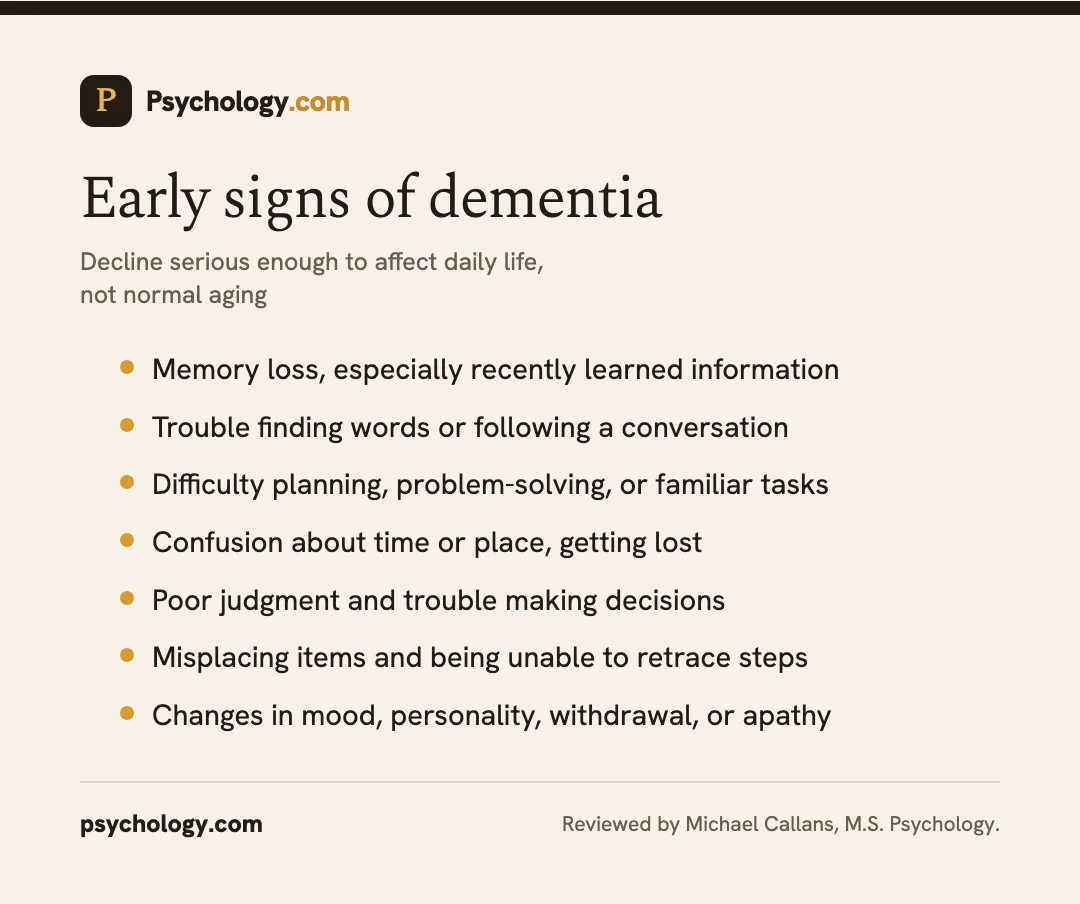
Symptoms vary depending on the cause and which parts of the brain are affected, but common signs include:
- Memory loss, especially forgetting recently learned information
- Difficulty finding the right words or following a conversation
- Trouble with planning, problem-solving, or completing familiar tasks
- Confusion about time or place, such as getting lost in familiar settings
- Poor judgment and difficulty making decisions
- Misplacing items and being unable to retrace steps
- Changes in mood, personality, or behavior, including withdrawal or apathy
- Difficulty with coordination or movement in some types
Cognitive symptoms tend to be progressive, meaning they worsen gradually over months and years. Early in the course they can be subtle and easy to attribute to stress or tiredness. The pattern of which abilities are affected first depends a great deal on the underlying disease, which is one reason an accurate diagnosis is so useful.
Types of dementia
Dementia has several distinct causes, and they differ in how they begin, how they progress, and which symptoms appear first. The National Institute on Aging describes the most common forms below.
- Alzheimer's disease: the most common cause, marked by the buildup of certain proteins (amyloid plaques and tau tangles) in the brain. It usually begins with short-term memory problems. See Alzheimer's disease.
- Vascular dementia: the second most common cause, due to reduced blood flow to the brain, often after a stroke or a series of small strokes. Problems with planning, judgment, and concentration may stand out as much as memory loss.
- Lewy body dementia: linked to abnormal protein deposits called Lewy bodies, often involving visual hallucinations, alertness that fluctuates through the day, and movement changes similar to Parkinson's disease.
- Frontotemporal dementia: affects the front and side regions of the brain and tends to strike at a younger age than Alzheimer's, often changing personality, behavior, or language before memory.
- Mixed dementia: more than one type present at the same time, most often Alzheimer's combined with vascular changes, which is common in older adults.
Diagnosis
There is no single test that confirms dementia. A doctor reaches a diagnosis by building a full picture over time. This usually includes a detailed medical history, often with input from family who have noticed changes, a physical and neurological examination, and brief cognitive tests of memory, attention, and problem-solving. Blood tests and brain imaging such as CT or MRI scans help rule out other causes and identify the likely type. Because some conditions that mimic dementia are treatable, the Alzheimer's Association emphasizes that a thorough evaluation is worth seeking early rather than waiting.
Causes and risk factors
Dementia is caused by damage to brain cells that disrupts how they communicate. Several factors raise the risk:
- Age: the strongest risk factor, with risk rising sharply after 65, though dementia is not inevitable with age.
- Family history and genetics: having a close relative with dementia can increase risk.
- Cardiovascular health: high blood pressure, diabetes, high cholesterol, smoking, and obesity all raise risk.
- Brain injury: a history of significant head trauma.
- Lifestyle: physical inactivity, social isolation, and untreated hearing loss are linked to higher risk.
Some causes of dementia-like symptoms, such as thyroid problems, vitamin deficiencies, infections, or medication side effects, are treatable, which is another reason to get an early evaluation. Importantly, not all risk is fixed. The World Health Organization notes that addressing modifiable factors, including physical inactivity, smoking, harmful alcohol use, high blood pressure, diabetes, obesity, depression, social isolation, and untreated hearing loss, may reduce the risk of developing dementia or delay its onset. None of these guarantees prevention, but they point to changes that support brain health across a lifetime.
How dementia is treated
Most forms of dementia cannot be cured, but treatment and good support can ease symptoms, slow decline in some cases, and protect quality of life for the person and their family.
Medication
Certain medications can temporarily improve or stabilize memory and thinking symptoms in some types of dementia. Others help manage mood, sleep, or behavioral changes. All should be managed by a prescriber, since benefits and side effects vary by person and type.
Therapies and daily support
Cognitive stimulation, structured routines, occupational therapy, and meaningful activity can help people stay engaged and independent for longer. Treating underlying conditions such as high blood pressure also supports brain health.
Caregiver and emotional support
Living with dementia affects the whole family. Counseling, caregiver education, support groups, and respite care reduce strain and help everyone cope. A therapist can also support family members through the grief and stress that often come with a diagnosis.
The scale of this caregiving is significant. The World Health Organization reports that informal caregivers, most often family members, spend on average around five hours a day supporting a person living with dementia, and the emotional, physical, and financial pressure on them is well documented. Looking after your own wellbeing is not a luxury in this situation; it is part of providing good care, because a caregiver who is depleted cannot sustain the support a loved one needs over the long course of the illness.
Worried about a loved one? Take the IQCODE-based dementia test (answered about a loved one): free, confidential, about 3 minutes, with an instant plain-language result and a PDF you can bring to a professional. A screening is not a diagnosis.
When to seek help
Talk to a doctor if you or a loved one notice persistent memory problems, confusion, difficulty with everyday tasks, or changes in mood or behavior. Do not assume these changes are just normal aging. An early evaluation can identify treatable causes, confirm a diagnosis, and open the door to support and planning while it can do the most good. To understand where normal forgetfulness ends and warning signs begin, see memory loss.
Frequently asked questions
What is the difference between dementia and Alzheimer's disease?
Dementia is an umbrella term for symptoms that affect memory and thinking. Alzheimer's disease is a specific brain disease and the most common cause of dementia. In other words, all Alzheimer's is dementia, but not all dementia is Alzheimer's. Learn more about Alzheimer's disease.
Is dementia a normal part of getting older?
No. Some mild changes in memory and processing speed are normal with age, but dementia involves a decline serious enough to interfere with daily life. That is not expected and should be evaluated. See memory loss for the difference.
Can dementia be prevented?
There is no guaranteed way to prevent it, but managing blood pressure, staying physically and socially active, treating hearing loss, not smoking, and protecting the head from injury can lower the risk.
Related conditions
Therapists who specialize in dementia
Connect with a licensed therapist on Psychology.com who works with dementia.
- Advance Thru Psychotherapy and Family Development
- Biofeedback Associates of Northeast Florida
- Dr. Camille Caiozzo
- Dr. Edward J. Mike
- Dr. Joe A Baez
- Dr. SARA J CORNELL
Finding the right help
When you are ready to take the next step, these guides walk you through finding and starting with the right therapist.
- Getting started with therapy
- How to find the right therapist
- Find a therapist who takes insurance
- Free & low-cost therapy
References
- National Institute on Aging (NIA). What Is Dementia? Symptoms, Types, and Diagnosis.
- National Institute on Aging (NIA). What Is Alzheimer's Disease?
- World Health Organization (WHO). Dementia fact sheet.
- Alzheimer's Association. What Is Dementia?
- Alzheimer's Association. Diagnosis of Alzheimer's and dementia.
- Mayo Clinic. Dementia: Symptoms and causes.