

Key facts
- Occasional forgetfulness is normal, especially with age, and is usually not a cause for alarm.
- Memory loss that disrupts daily life is not a normal part of aging and should be evaluated.
- Many causes of memory problems, such as stress, sleep loss, or medication, are treatable or reversible.
- Mild cognitive impairment can be an in-between stage between normal aging and dementia.
What is memory loss?
Memory loss, or forgetfulness, is the inability to recall information, events, or experiences that you would normally expect to remember. It exists on a spectrum. At one end are the small lapses everyone has, like blanking on a name. At the other end are serious memory problems that interfere with daily life and may point to a medical condition.
The most important thing to understand is the difference between normal aging, mild cognitive impairment, and dementia. These are not the same, and the distinction has real consequences for what to do next. The National Institute on Aging emphasizes that while some forgetfulness can be a normal part of aging, memory problems that disrupt daily life are not, and they are worth discussing with a doctor. Sorting out where you or a loved one falls is exactly why an evaluation can be so reassuring or so useful.
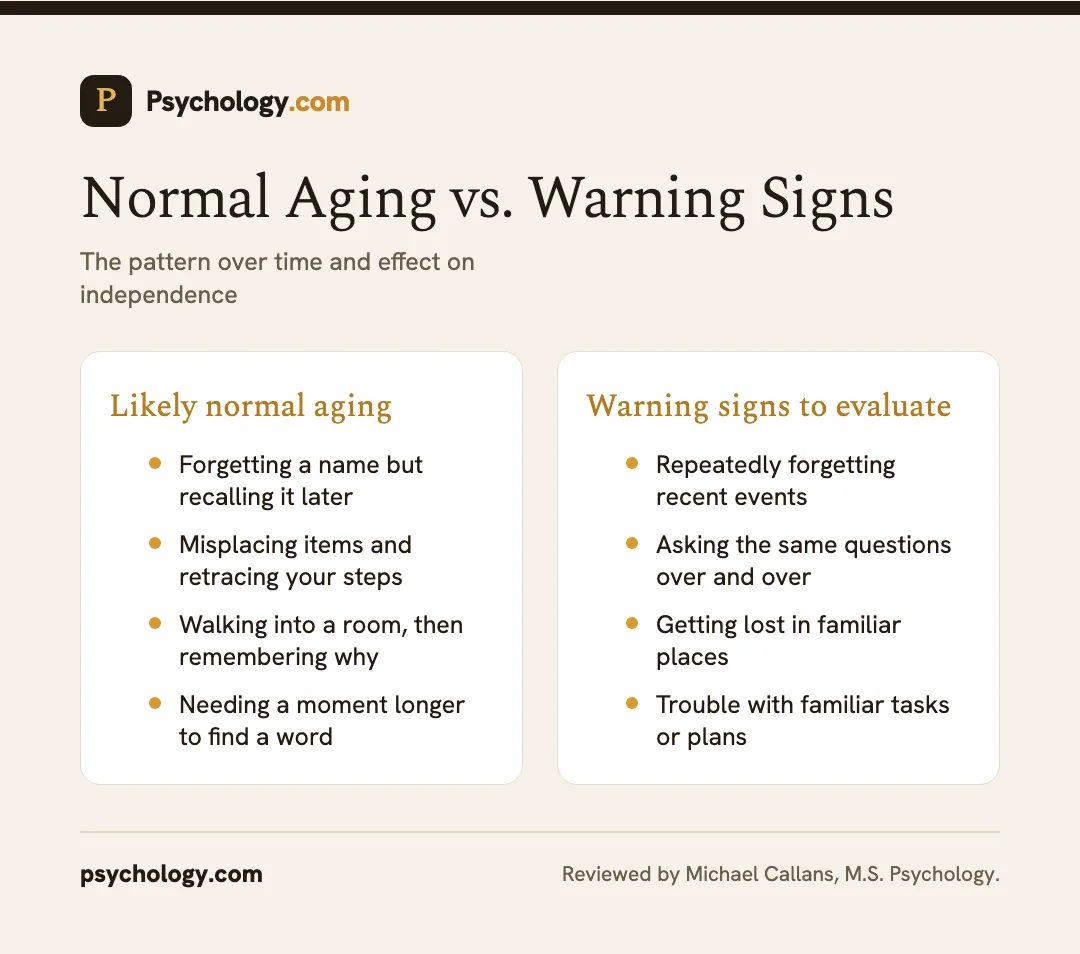
Normal aging versus warning signs
Some change in memory and processing speed is a normal part of getting older. The brain naturally becomes a little slower at recalling names or learning new information, but this does not stop you from living independently. Occasionally forgetting where you left your keys and then finding them is very different from forgetting what keys are for.
Likely normal aging:
- Occasionally forgetting names or appointments but remembering them later
- Misplacing items from time to time and being able to retrace your steps
- Walking into a room and forgetting why, then recalling it
- Needing a moment longer to find a word
Warning signs worth evaluating:
- Forgetting recently learned information or important events repeatedly
- Asking the same questions over and over
- Getting lost in familiar places or losing track of dates and seasons
- Difficulty following or joining a conversation
- Trouble completing familiar tasks or making plans
- Misplacing things in unusual places and being unable to retrace steps
- Changes in mood, judgment, or personality noticed by others
A useful rule of thumb is the effect on independence and the pattern over time. Forgetting a name and recalling it later is ordinary. Repeatedly forgetting recent conversations, struggling with tasks you have done for years, or having others notice a clear change is a different matter and deserves a professional look. Concerns raised by family or friends are worth taking seriously, since the person experiencing the changes is not always the first to notice them.
Mild cognitive impairment and dementia
It helps to picture three points along a continuum: normal age-related change, mild cognitive impairment, and dementia.
Mild cognitive impairment (MCI) is a stage between the expected changes of normal aging and the more serious decline of dementia. People with MCI have memory or thinking problems greater than expected for their age, noticeable to themselves and often to others, but they can still manage daily life independently. The National Institute on Aging notes that MCI does not always progress to dementia; in some people the symptoms stay stable, and in some they improve, especially when a treatable cause is found and addressed. Because MCI can be an early warning sign for some people, ongoing follow-up is sensible.
Dementia is when the decline in memory and thinking becomes serious enough to interfere with independent daily functioning, such as managing money, taking medication correctly, or keeping appointments. It is an umbrella term, not a single disease, and Alzheimer's disease is its most common cause. The boundary between MCI and dementia is essentially about independence: when thinking problems start to require regular help from others, the picture has crossed into dementia. To learn more about each, see dementia and Alzheimer's disease.
Causes and risk factors
Memory problems have many possible causes, and an encouraging number of them are treatable or even reversible. The National Institute on Aging lists several health conditions and lifestyle factors that can cause memory problems that improve once the cause is treated. Common contributors include:
- Stress, anxiety, and depression: emotional health strongly affects concentration and recall. Depression in particular can cause memory and thinking problems that closely mimic dementia but improve with treatment. See depression and anxiety.
- Poor sleep: the brain consolidates memories during sleep, so ongoing sleep loss impairs both forming and retrieving memories.
- Medications: some drugs, alone or in combination, can affect memory; a medication review sometimes resolves the problem.
- Medical conditions: thyroid problems, vitamin deficiencies (such as low B12), infections, and head injuries.
- Alcohol and substance use: can interfere with memory in the short and long term.
- Neurological conditions: including MCI, dementia, and stroke.
Because so many of these are addressable, an evaluation often brings good news, or at least a clear and actionable explanation, rather than the worst-case scenario people fear.
Care and support
How memory problems are addressed depends entirely on the cause, which is why evaluation comes first.
Finding and treating the cause
A doctor can review medications, check for treatable conditions, and run cognitive and medical tests. The evaluation often includes blood tests to look for thyroid problems or vitamin deficiencies, a review of mood and sleep, and brief memory and thinking tests. When the cause is reversible, such as a vitamin deficiency, an underactive thyroid, poor sleep, depression, or a medication side effect, treating it often restores memory. When the cause is a progressive condition, identifying it early still opens the door to treatment, planning, and support while they can do the most good.
Supporting brain and emotional health
Regular physical activity, consistent sleep, a balanced diet, social connection, and mentally engaging activity all support memory. The Mayo Clinic notes that staying physically and mentally active, staying socially engaged, eating well, and managing chronic conditions all help protect memory as we age. Because stress, anxiety, and depression are common and very treatable contributors, addressing emotional health can make a real difference, sometimes a dramatic one.
Practical strategies
Calendars, reminders, notes, a dedicated place for important items such as keys and wallet, and consistent daily routines all reduce the impact of everyday forgetfulness and help people stay independent and confident. These habits are useful whether memory changes turn out to be benign or part of something that needs ongoing care.
Worried about a loved one? Take the IQCODE-based dementia test (answered about a loved one): free, confidential, about 3 minutes, with an instant plain-language result and a PDF you can bring to a professional. A screening is not a diagnosis.
When to seek help
See a doctor if memory problems are getting worse, happening more often, or interfering with daily life, or if family members have raised concerns. Do not assume it is just aging. Many causes are treatable, and even when the cause is more serious, early evaluation opens the door to support, planning, and care. Seek prompt attention for sudden memory loss, confusion, or memory loss after a head injury.
Frequently asked questions
Is forgetfulness always a sign of dementia?
No. Occasional forgetfulness is normal, and most memory lapses are not dementia. Many causes, including stress, poor sleep, and certain medications, are treatable. Memory loss that disrupts daily life is what warrants evaluation. See dementia.
What is the difference between normal aging and a real problem?
Normal aging might mean briefly forgetting a name but recalling it later, without affecting independence. A real problem means forgetting recent events repeatedly, getting lost in familiar places, or struggling with daily tasks. Those signs deserve a professional look.
Can memory loss be reversed?
Sometimes. When memory problems come from treatable causes such as depression, anxiety, sleep loss, medication, or a vitamin deficiency, addressing the cause often improves memory. That is why getting evaluated is worthwhile.
Related conditions
Finding the right help
When you are ready to take the next step, these guides walk you through finding and starting with the right therapist.
- Getting started with therapy
- How to find the right therapist
- Find a therapist who takes insurance
- Free & low-cost therapy
References
- National Institute on Aging (NIA). Memory Problems, Forgetfulness, and Aging.
- National Institute on Aging (NIA). What Is Mild Cognitive Impairment?
- Mayo Clinic. Memory loss: When to seek help.
- Mayo Clinic. Memory loss: 7 tips to improve your memory.
- Alzheimer's Association. 10 Early Signs and Symptoms of Alzheimer's and Dementia.
- NHS. Memory loss (amnesia).