

Key facts
- Asperger syndrome is no longer a separate diagnosis. Since the DSM-5 (2013), it is included within autism spectrum disorder (ASD).
- It described autistic people with strong language and intellectual skills alongside social and sensory differences.
- Many people diagnosed before 2013 still identify with the term, and that choice is valid.
- Understanding and tailored support help people with this profile communicate, work, and thrive.
What is Asperger syndrome?
Asperger syndrome was historically used to describe people who showed the social communication and sensory differences associated with autism, but without delays in language development or intellectual ability. People with this profile often have average or above-average intelligence and fluent language, alongside differences in social interaction and a tendency toward focused, deep interests. The term came from the work of Hans Asperger in the 1940s and entered formal diagnosis in the 1990s.
It is important to know that Asperger syndrome is no longer a separate clinical diagnosis. In 2013, the DSM-5 folded it, along with several related diagnoses, into the single category of autism spectrum disorder (ASD). The UK's National Health Service likewise notes that Asperger's is now part of the autism spectrum and is no longer used as a separate diagnosis. Clinicians today diagnose autism rather than Asperger syndrome. For a fuller picture, see our guide to autism.
How it relates to autism today
What was once called Asperger syndrome is now understood as part of the autism spectrum. The change reflected research showing that these profiles share the same core features as autism and exist along a continuum, rather than forming a clearly separate condition. Drawing a hard line between "Asperger's" and "autism" proved unreliable in practice, with different clinicians reaching different conclusions for similar people. Under the DSM-5, clinicians instead describe autism along with a level of support needed (levels 1 to 3). A person who would previously have received an Asperger diagnosis would today typically be diagnosed with autism spectrum disorder described as level 1, meaning lower support needs. Autism overall is common: the Centers for Disease Control and Prevention estimates about 1 in 31 US children aged 8 has been identified with autism spectrum disorder, the category that now includes this profile.
Some people also distance themselves from the Asperger name because of historical concerns about Hans Asperger's record during the Nazi era. At the same time, many people diagnosed before the change continue to use the term Asperger's or describe themselves as "Aspie," and that is a personal and valid choice. Language around identity belongs to the person who lives it.
Traits and characteristics
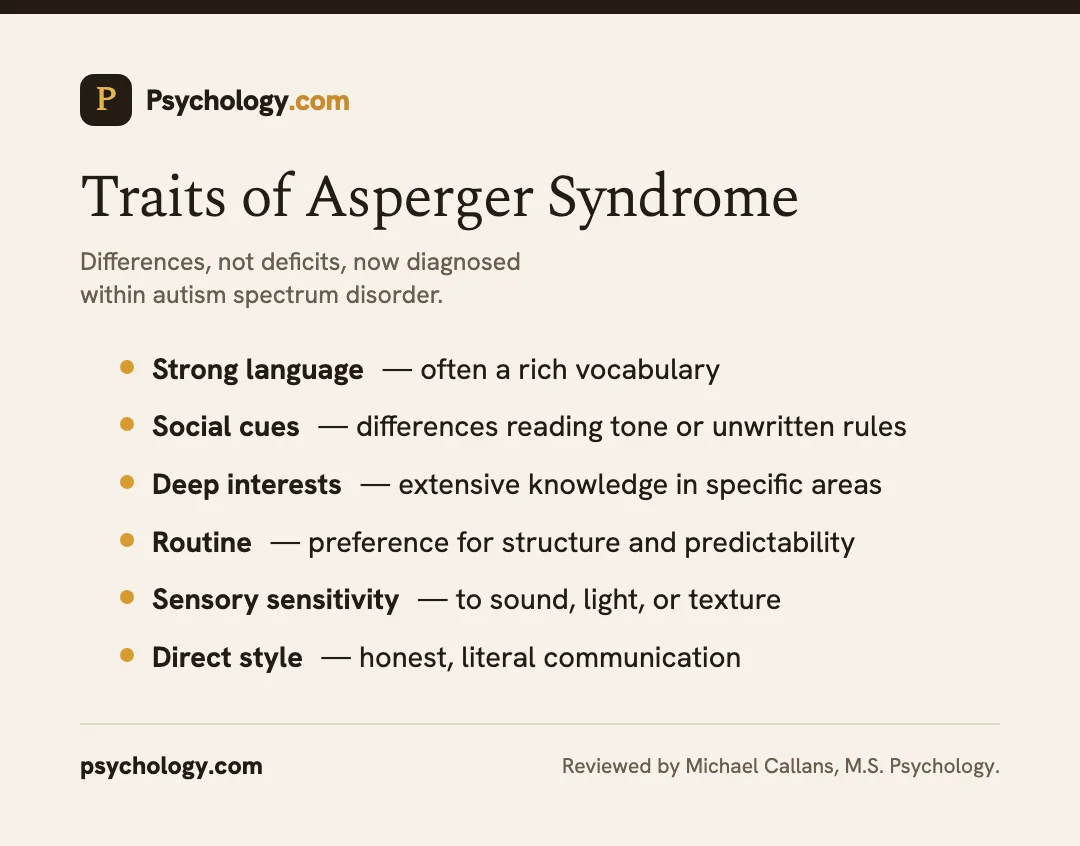
People with this profile tend to share certain characteristics, which vary from person to person:
- Strong language skills and often a rich vocabulary
- Differences in reading social cues, tone, or unwritten social rules
- Deep, focused interests and extensive knowledge in specific areas
- Preference for routine, structure, and predictability
- Sensory sensitivities to sound, light, texture, or other input
- A direct, honest communication style
These are differences rather than deficits, and many are genuine strengths in the right environment. As with autism generally, the CDC groups these characteristics into differences in social communication and interaction, and restricted or repetitive behaviors and interests, frequently alongside sensory sensitivities.
In daily life, the same traits can be a strength in one setting and a challenge in another. Deep, focused interests can translate into genuine expertise and rewarding careers. A direct, literal communication style can mean reliability and honesty, while also leading to misunderstandings when others rely on hints or unspoken rules. Many people in this profile also describe masking, the effort of consciously copying social behavior to fit in, which can be exhausting and contribute to anxiety or burnout over time. Understanding the profile often makes these patterns easier to manage with self-compassion rather than self-criticism.
How it is diagnosed
Because Asperger syndrome is no longer a separate diagnosis, a clinician today assesses for autism spectrum disorder. Diagnosis is based on a detailed developmental history, direct observation, and structured assessment tools carried out by a specialist such as a psychologist or psychiatrist. There is no blood test or scan. Where helpful, the clinician also documents the level of support a person needs and screens for co-occurring conditions such as anxiety or ADHD.
Many people with this profile are diagnosed later in life, particularly women and those who have learned to mask their traits in order to fit in. A later diagnosis can bring relief, self-understanding, and access to support, accommodations, and community. For adults seeking assessment, a primary care doctor can usually refer you to a clinician experienced with autism.
Wondering where you stand? Take the AQ-based autism test or the autism masking test (CAT-Q): free, confidential, about 3 minutes, with an instant plain-language result and a PDF you can bring to a professional. A screening is not a diagnosis.
Support and treatment
This profile of autism is not an illness to be cured. Support focuses on the areas a person finds challenging while respecting who they are.
Practical and psychological support
Counseling, social-skills support where a person wants it, and occupational therapy for sensory and daily-living needs can all help. Cognitive behavioral therapy is useful when anxiety or low mood are present, which is common, and approaches are usually adapted to suit autistic thinking styles. There is no medication for autism itself, though medication can help with specific co-occurring difficulties when present.
Accommodations
Adjusting the environment often helps more than trying to change the person. Clear and direct communication, predictable routines, advance notice of change, sensory-friendly spaces, and understanding from schools and workplaces frequently make the biggest difference.
Support for co-occurring conditions
People with this profile may also experience anxiety, depression, or ADHD. Addressing these, when present, can significantly improve wellbeing.
When to seek help
Consider an assessment if long-standing social, sensory, or routine-related differences affect daily life, relationships, school, or work, or if you simply want to understand yourself or your child better. There is no age limit on seeking clarity. A diagnosis is not a label that limits a person; for many it opens the door to support, workplace and school accommodations, and a community of people with shared experiences. If anxiety, low mood, or burnout are part of the picture, those can be addressed alongside understanding the underlying profile.
Frequently asked questions
Is Asperger syndrome still a diagnosis?
No. Since the DSM-5 in 2013, Asperger syndrome is no longer a separate diagnosis and is included within autism spectrum disorder. Clinicians now diagnose autism, though many people still use the term Asperger's to describe their identity.
What is the difference between Asperger's and autism?
They are not separate conditions. Asperger syndrome described a profile of autism with strong language and intellectual ability. Today it is understood as part of the autism spectrum, typically with lower support needs. See our guide to autism for more.
Should I still use the term Asperger's?
That is a personal choice. Many people diagnosed before 2013 identify strongly with the term, while others prefer "autistic." Both are valid, and the words a person uses for their own identity are theirs to choose.
Related conditions
Therapists who specialize in asperger syndrome
Connect with a licensed therapist on Psychology.com who works with asperger syndrome.
- Biofeedback Associates of Northeast Florida
- Cheri Albertson
- Donna Ulanowski
- Dr. Joe A Baez
- Dr. Judith Nelson Lowenthal
- Dr. Ken Counts
Finding the right help
When you are ready to take the next step, these guides walk you through finding and starting with the right therapist.
- Getting started with therapy
- How to find the right therapist
- Find a therapist who takes insurance
- Free & low-cost therapy
References
- National Institute of Mental Health. Autism Spectrum Disorder.
- Centers for Disease Control and Prevention. Signs and Symptoms of Autism Spectrum Disorder.
- Centers for Disease Control and Prevention. Data and Statistics on Autism Spectrum Disorder.
- National Health Service (UK). What is autism?.
- World Health Organization. Autism (fact sheet).