Feelings Wheel (Free Printable PDF): Name What You Are Feeling in Under a Minute
A feelings wheel helps adults name emotions and explain what they need. Use this wheel of emotions online or get the free printable PDF with labeled and blank versions.

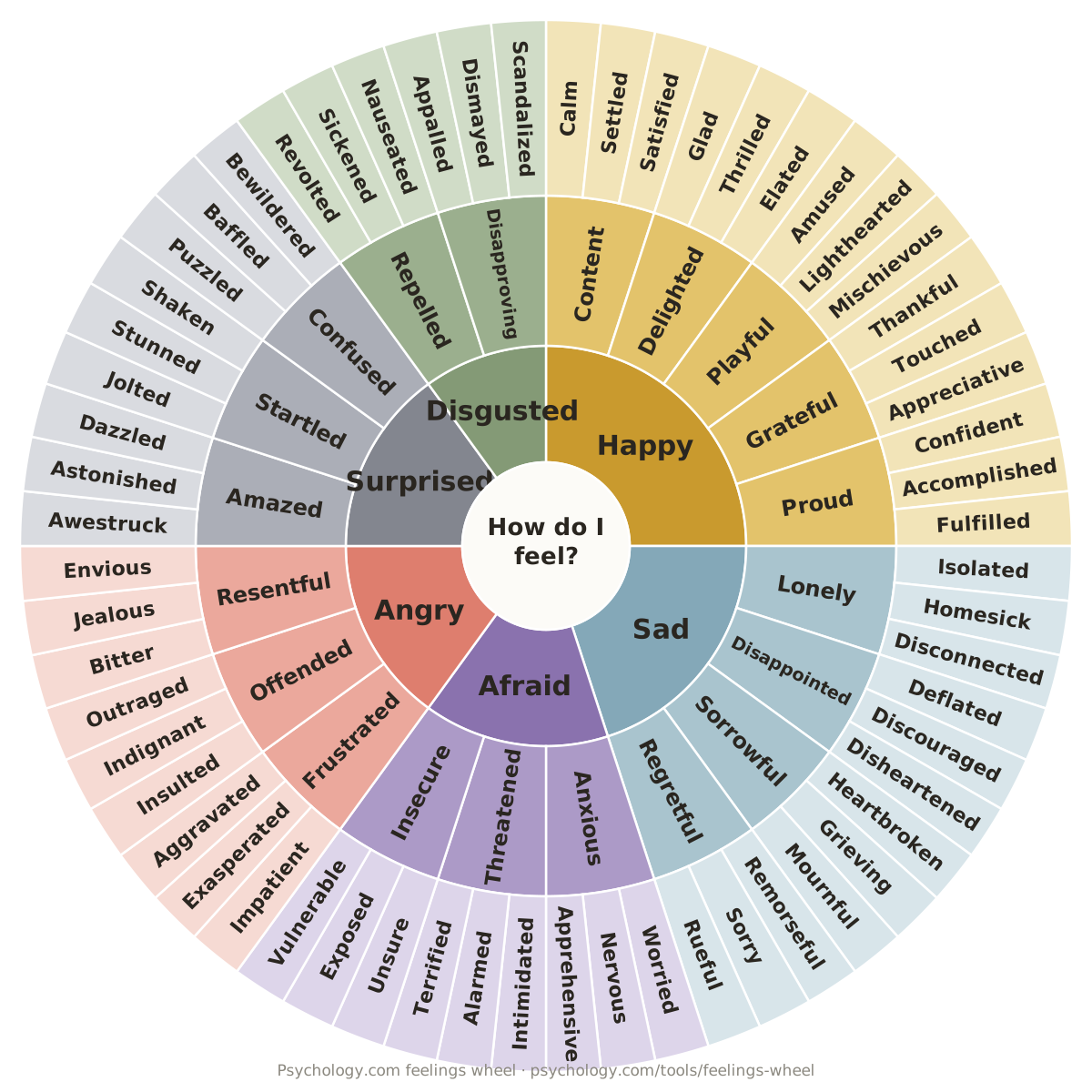
Emotions wheel vs feelings wheel
An emotions wheel and a feelings wheel help you find words for your experience. People often use the names interchangeably, so the name alone does not tell you which model you are looking at. Check the labels and how the wheel groups them. Different wheels can organize similar words in different ways.
A feelings wheel usually works as a vocabulary guide. You start with a broad word, such as angry or sad, then explore specific possibilities. You can also begin at the outside if a word catches your attention. There is no required route, and choosing several words is fine. The aim is to describe your experience, not get a correct answer.
An emotions wheel may instead refer to Robert Plutchik's model, which shows relationships among primary emotions, their intensity, and combinations. Gloria Willcox's Feeling Wheel has a different arrangement. Psychology.com's printable wheel draws on the idea of expanding emotional vocabulary, with its own selection and grouping of words; it does not reproduce either model exactly.
Choose whichever format makes reflection easier. Use a wheel when visual groupings help, or a written list when you want to scan words. Neither format is a diagnostic test or a substitute for therapy. Print the blank feelings wheel to write in your own words, or use the adult feelings wheel on screen.
How to use the feelings wheel
- Pause and describe the moment. Notice what happened, any body sensations, and your first words for the feeling. Example: after learning that a project they hoped to lead went to a coworker, Alex says, "I feel bad."
- Choose the closest core. Alex notices sadness about the missed opportunity and chooses Sad. If two cores fit, keep both; there is no single correct route.
- Read the middle words in that family. Alex chooses Disappointed because the outcome fell short of what they had hoped for.
- Try the outer words and check the fit. Under Disappointed, Alex finds Deflated, Discouraged, and Disheartened. Deflated fits the sudden loss of enthusiasm. Their completed route is "bad" to Sad to Disappointed to Deflated.
- Put the word in a sentence and choose one response. Alex writes, "I feel deflated because I wanted this opportunity." They ask their manager what would help them prepare for the next opening. The label helped them identify the missed opportunity and make a specific request; it did not remove the disappointment.
- Check again later. Keep the word if it still fits, add another, or use your own. In the text equivalent below, each heading is a core, each column title is a middle word, and the words beneath it are its outer choices.
Happy
Content
Calm, Settled, Satisfied
Delighted
Glad, Thrilled, Elated
Playful
Amused, Lighthearted, Mischievous
Grateful
Thankful, Touched, Appreciative
Proud
Confident, Accomplished, Fulfilled
Sad
Lonely
Isolated, Homesick, Disconnected
Disappointed
Deflated, Discouraged, Disheartened
Sorrowful
Heartbroken, Grieving, Mournful
Regretful
Remorseful, Sorry, Rueful
Afraid
Anxious
Worried, Nervous, Apprehensive
Threatened
Intimidated, Alarmed, Terrified
Insecure
Unsure, Exposed, Vulnerable
Angry
Frustrated
Impatient, Exasperated, Aggravated
Offended
Insulted, Indignant, Outraged
Resentful
Bitter, Jealous, Envious
Surprised
Amazed
Awestruck, Astonished, Dazzled
Startled
Jolted, Stunned, Shaken
Confused
Puzzled, Baffled, Bewildered
Disgusted
Repelled
Revolted, Sickened, Nauseated
Disapproving
Appalled, Dismayed, Scandalized
When the feelings wheel helps
Try it during a journal check-in, after a difficult conversation, or before explaining what you need to someone. You can also use it to notice enjoyable moments and describe what made them meaningful. Choose one word and add a short sentence about what happened; there is no need to fill every segment.
The blank version gives you space for words from your own language, family, or culture. You can use the text lists without the graphic, and color is not needed to follow the hierarchy.
What the wheel cannot tell you
The wheel cannot diagnose a condition, explain another person's intentions, or tell you what action you must take. A feeling is information about your experience, not proof that your interpretation of an event is correct.
Some entries describe related responses as well as emotions. For example, Confused can accompany surprise, while Nauseated describes a body sensation that can accompany disgust. Words can overlap across families, and the outer ring does not always mean a stronger feeling. Disgust words describe your reaction, not anyone's worth.
If searching for a label leaves you more upset or stuck, pause and return later. Your own description is enough. If difficult feelings persist or interfere with daily life, consider talking with a licensed mental health professional. If the wheel feels like too many words at once, start with the simpler feelings chart and graduate to the wheel later. When you have found the word, our free identifying emotions worksheet for adults PDF connects it to body cues and the need underneath. If the feeling you keep landing on is loss, our free grief worksheets give those words a place to go, in whatever order the days bring. Because a feeling is information rather than proof, the check the facts DBT worksheet is a natural next step for checking your interpretation of the event.
Related tools & tests
Want help making sense of your feelings?
A therapist can help you explore what you feel, what matters to you, and how you want to respond. Search our directory.
About this tool
A feelings wheel is a visual guide to emotion words that helps you describe an experience when you feel stuck with broad labels such as bad or fine. This free wheel of emotions PDF gives adults a labeled guide and a blank printable for finding words that fit. For more words in a format you can scan, explore our list of emotions and feelings. A feelings wheel groups emotion words in three rings so you can explore what you feel. This adult version starts with Happy, Sad, Afraid, Angry, Surprised, and Disgusted. Each core branches into middle words and then related outer words. Read outward for more choices, or start with any word that fits. You can name several feelings at once, and you do not need to reach the outer ring.
Gloria Willcox described The Feeling Wheel in the Transactional Analysis Journal in 1982 as a tool for recognizing and communicating feelings. Her three-ring format and Robert Plutchik's work on relationships among emotions inform the idea of using a wheel. Plutchik's model describes eight primary emotions, their intensity, and their combinations; it is a different arrangement from the vocabulary guide on this page (Willcox, 1982; Plutchik, 2001).
Naming an emotion is called affect labeling. In a brain-imaging experiment, Lieberman and colleagues (2007) found that labeling negative emotional images was associated with a smaller amygdala response than comparison tasks. This offers a reason to explore naming feelings, but it does not show that this wheel will make you feel calmer or treat a mental health condition. A useful label can also give you clearer language for a conversation.
Psychology.com's wheel uses an original selection and arrangement of words. Its six cores follow the familiar Ekman lineage, with Happy as an everyday label for enjoyment (Paul Ekman Group, Universal Emotions). The middle and outer groupings are editorial vocabulary choices, not categories established by that research. They include related experiences and responses, and some words could fit more than one family. This is a starting point for reflection, not a complete map of emotion or a validated assessment.
The feelings wheel PDF download on this page is free, includes both the labeled wheel and the blank version in one file, and needs no email or signup. It is designed for adults, using words like disheartened and indignant rather than simpler child vocabulary. If you want an option for kids, a shorter Feelings Chart with basic words may fit better. Before printing, check the print preview so the outside words stay within the page margins. If small labels are difficult to read, use the on-page text lists and write your chosen words on the blank version. You can keep the labeled sheet as a reference without marking every feeling you recognize.
After choosing a word, separate the feeling from the explanation you give it. For example, you might write, "I feel lonely after my friend canceled," while leaving open why they canceled. Then name a practical need, such as company, rest, or clarification. The completed wheel is a record of your description at that moment; it has no score, cutoff, or required emotional destination.
If finding a precise label feels difficult, write a body sensation or an everyday phrase beside the wheel and return when you feel ready. You can bring that description to a therapist without completing the page. Psychology.com's therapist directory can help you look for support when feelings interfere with sleep, relationships, or daily responsibilities. The Anxiety Test is a separate screening option if persistent worry is part of what you are noticing. Explore the free tools library for other exercises you can use alongside this printable.

I've had a lot of success using the feelings wheel with clients in session and as a tool clients can use on their own outside of session. While it can be used from the inside out, as described here, I've also found working from the outside in especially helpful for neurodivergent clients, who may be able to identify an intellectual insight, such as "I feel insulted," fairly quickly, but struggle to connect that insight to a core emotion, such as anger. Working inward can help bridge that gap and work towards emotional insight and a better understanding of yourself. However it's used, the feelings wheel is a simple but powerful tool.
References
- Willcox G. The Feeling Wheel: A tool for expanding awareness of emotions and increasing spontaneity and intimacy. Transactional Analysis Journal. 1982;12(4):274-276. https://doi.org/10.1177/036215378201200411
- Plutchik R. The nature of emotions. American Scientist. 2001;89(4):344-350. https://www.jstor.org/stable/27857503
- Lieberman MD, Eisenberger NI, Crockett MJ, Tom SM, Pfeifer JH, Way BM. Putting feelings into words: Affect labeling disrupts amygdala activity in response to affective stimuli. Psychological Science. 2007;18(5):421-428. https://doi.org/10.1111/j.1467-9280.2007.01916.x
- Paul Ekman Group. Universal emotions. https://www.paulekman.com/universal-emotions/ Accessed September 8, 2026.
Cite this source
Psychology.com. (2026, October 18). Feelings Wheel (Free Printable PDF). Psychology.com. https://psychology.com/tools/feelings-wheel
Feelings Wheel (Free Printable PDF) FAQ
Is there a free PDF or printable feelings wheel?
Yes. Use the downloads on this page for a free printable PDF with the labeled wheel and a blank version to fill in. The full word hierarchy is also available in text on this page. The feelings wheel PDF includes adult vocabulary, and you can circle words or write your own on the blank printable. Choose the version that is easiest for you to read and use.
How do I use the feelings wheel?
Pick a core feeling, read its middle words, then try an outer word. For example, Sad can lead to Disappointed and then Deflated. Add what happened and one possible next step. You can choose more than one word or stop at any ring.
What is the difference between a feelings wheel and an emotions wheel?
People often use the names interchangeably for a circular guide to emotion words. A specific model can differ: Willcox's Feeling Wheel uses six cores, while Plutchik's wheel describes eight primary emotions, intensity, and combinations. This page offers an original six-core vocabulary wheel.
Is the feelings wheel evidence-based?
Its broad emotion families draw on emotion research, and experiments such as Lieberman and colleagues' 2007 study support investigating affect labeling. That research did not test this wheel. Its word selection and placement have not been validated as an assessment, and it is not a treatment.
Do you offer a feelings wheel for kids?
This page offers the adult version, including a blank printable. We do not offer a separate kids version here. An adult can help a child explore a few familiar words, but this wheel has not been validated for children. For a simpler starting point, try the Feelings Chart and let the child choose or describe a feeling in their own words.
How many feelings does the wheel include?
This wheel has six core emotions: Happy, Sad, Afraid, Angry, Surprised, and Disgusted. Each core branches into two to five middle words, and each middle word branches into three related outer words, for roughly 80 feeling words in total. Start at any ring, and use as many or as few words as fit your experience.
Where can I get a wheel of emotions PDF free download for adults?
The wheel of emotions PDF free download for adults on this page needs no email or signup. One file holds the labeled wheel and the blank version, and it uses adult vocabulary such as disheartened, indignant, and rueful rather than simpler child words. Check the print preview first so the outer words stay inside the page margins. It is Psychology.com's original six-core arrangement, not Plutchik's model, which describes eight primary emotions, their intensity, and combinations in a different layout.
What makes this an emotion wheel for adults?
This emotion wheel for adults uses words adults actually reach for, like disheartened, indignant, and bewildered, instead of the simpler vocabulary on wheels made for children. Six cores, Happy, Sad, Afraid, Angry, Surprised, and Disgusted, branch into middle and outer words for roughly 80 feeling words in total. Read it as an emotional wheel chart on screen, or print the PDF and circle your choices. It is an educational vocabulary guide, not a validated assessment, and we do not offer a separate kids version here.